Showing posts with label flavor. Show all posts

Sunday, February 12, 2012

A Crabby Valentine

Because what says love like Crab Cakes for Two, eh? And these are no ordinary crab cakes, they're deliciously savory, flavorful crab-cakey goodness. Oh, and they're heart shaped, so yeah....  I've had two cans of crab meat sitting in my cabinets for a while now, and I promised my boyfriend seafood for Valentine's day (we try to avoid the overcrowded, overpriced restaurant thing). So I grabbed a bowl and threw some ingredients together. Given how on the fly these were made, I was expecting crab cakes that were simply good.  Instead I got tasty, melt-in-your-mouth awesomeness.  Best of all, it was disgustingly easy, so I highly recommend that you join me in making these for your Valentine sweetie.

What You'll Need
Supplies
Cutting board                                                                   Mixing bowl
Knife for chopping                                                           Mixing spoon
Sealable baggie                                                                Large cast iron skillet
Ingredients
2 6 oz cans white crab meat                                            Salt and pepper to taste
3 green onions                                                                  30 Ritz crackers
1/2 Tbsp parsley flakes                                                  3 Tbsp mayonnaise
3/4 tsp Old Bay Seasoning                                              1 cup olive oil

Now Let's Make Crab Cakes for Two!
Watch the fingers!
Begin by opening and draining off all the water on your canned crab meat.  Dump the crab meat into your large mixing bowl.  Next, chop your green onions.  The easiest way to do this is to line the onions up together and began chopping (it's really more of a half slicing, half chopping motion) at the green end until you get to the bottom of the onion that is all white.  Discard the white parts. Scrape the green onion into your large mixing bowl.

No need to be crabby.
Now, measure out 1/2 Tbsp parsley flakes and add them to the bowl. You can use a couple sprigs of chopped fresh parsley if you want; it's more colorful, but I didn't have any on hand. Measure out 3/4 tsp of Old Bay Seasoning and add it to the bowl.  It must be Old Bay; anything else is just... wrong. Next, add salt and pepper to taste; I used maybe 1/2 tsp salt and 1 tsp black pepper.  It definitely doesn't need more salt than that, but the pepper is pretty negotiable. Gently mix the ingredients together until you have a more uniform distribution.

Now take your sealable baggie, put in about 10 ritz crackers, and seal the bag, carefully pressing out any air.  Now smash (insert Hulk jokes into your cooking process now).  This is the easiest, cleanest way to generate cracker crumbs.  Using the baggie keeps crumbs from getting everywhere and prevents waste (/lecture). Add the crumbs to the bowl and repeat until all 30 crackers are crumbled.

I know I said no lumps...
Add 3 Tbsp of mayo and mix. You want a fairly even texture by the time your done mixing; no lumps, please.  Once blended, divide the crab mixture into four even parts in the bowl.  Refrigerate for about 5 minutes.  Chilling the mixture makes it a little less gooey and more workable for the next step. Take this time to prepare any other dishes you're serving or set up some candles. (Romance, people, romance!)

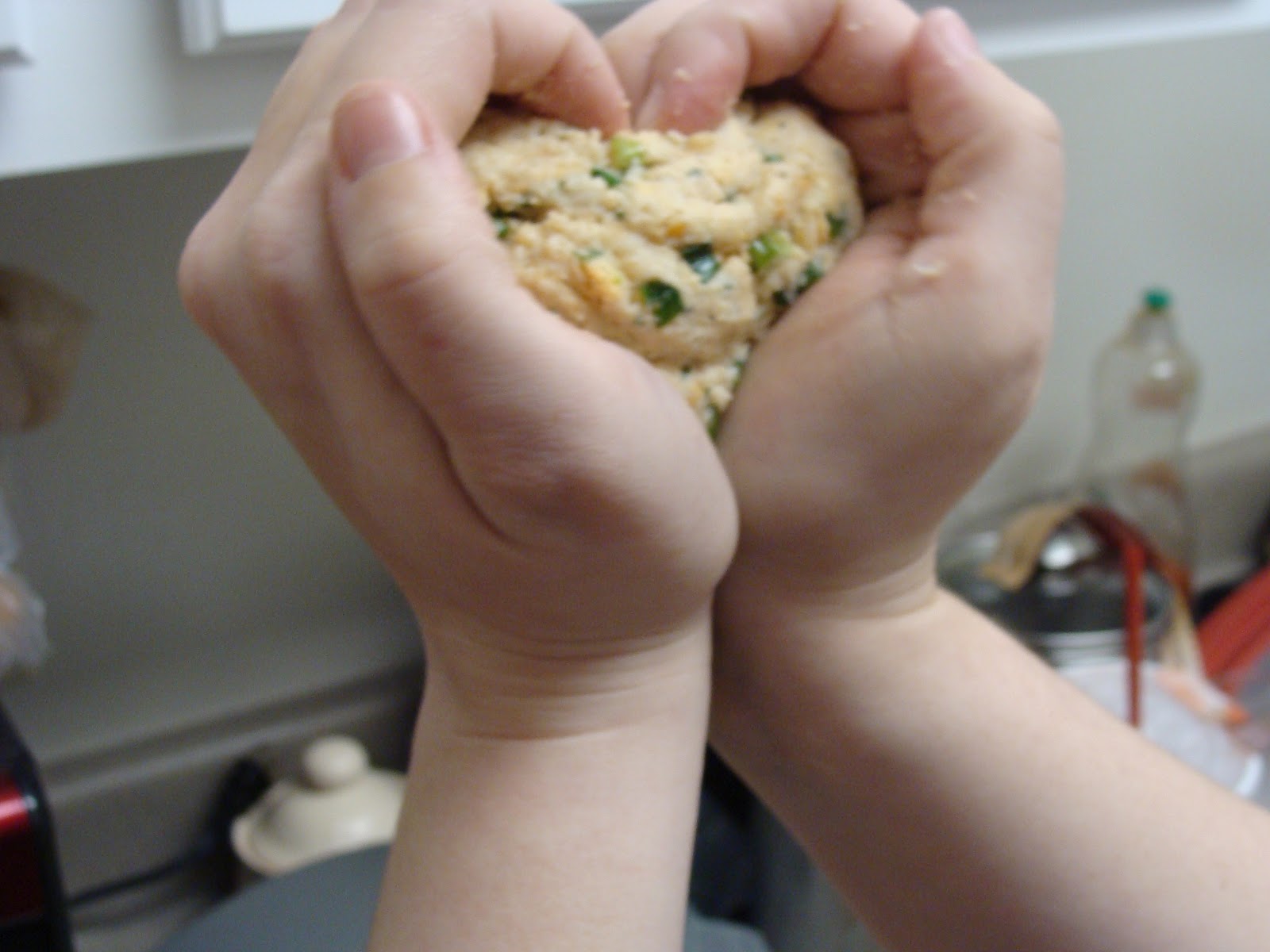
Remove the crab from the refrigerator. Take one of the four divided parts and roll it into a ball between your hands (clean hands, clean hands!).   Squish the ball between your hands to flatten it.  You want it fairly flat - about 3/4 of an inch thick.  Now cradle the flattened crab cake in your hands so that the flat surfaces face out and your hands are around the thinner edge. (Okay, see the 2nd picture if I'm being confusing). Curl your fingers down to form a heart with your hands (and, incidentally, the crab cake).  Flatten and repeat until you're satisfied with the shape of your heart shaped crab cake.  Set aside and repeat this process for the remaining three.


Ignore the irony.
Heat 1 cup of oil in your skillet over medium-high heat.  Do not put the crab cakes in until the oil is hot enough, or you'll be steeping your cake in oil. (Mumph). How do you tell if your oil is hot enough? Well, for starters, don't touch it (that's a no brainer, right? RIGHT?). Just barely wet your fingers and then flick a very small amount of water off of them into the oil (maybe stand back a little, just in case). If it sizzles and pops, your oil is ready.   Add all four crab cakes and cook on one side until it is dark brown. Flip and repeat.  Remove from oil.  Pat dry to remove excess oil if desired.

Who's an awesome girlfriend? This girl.
If you're not ready to serve your meal yet, the crab cakes respond well to being held warm in an oven.  Serve with your choice of delicious sides under candlelight (and yes, the lack of candlelit romance will totally affect the flavor).  The fettuccine tossed with the tiniest bit of alfredo seen here was particularly tasty paired with the crab cake.  Also, while this is the first Crab Cake I've ever had that didn't need Tabasco sauce, it still pairs nicely with it if you can't resist.

My chocolates now.
Happy Valentine's Day and stuff, hoomans.

    Pin It

Sunday, January 22, 2012

Let's Talk about Quiche

Cause really, who doesn't want to? (*glares menacingly*) Quiche is something of a family tradition on my mother's side, likely because her parents were so fond of French cuisine.  Today's recipe is for Ham and Cheese Quiche, and is only loosely based off my family recipe.  Quiche is easily adaptable to fit whatever is in your fridge at the time, so long as you get the basic custardy goodness down. This particular quiche version was inspired by my need to use up the last of the New Year ham. (waste not!) The recipe below is for two quiches, since I had two pie crusts, but the original is for one, and this recipe can be easily halved.

What You'll Need
Supplies
Large mixing bowl                                                   Cheese grater
Mixing spoon                                                            Liquid measuring cup
Medium mixing bowl                                                2 pie plates
Whisk
Ingredients
8 eggs                                                                       1/2 cup parmesan cheese
2 cans cream of onion soup                                       salt and pepper to taste
8 oz swiss cheese                                                      6-8 oz leftover ham
8 oz white cheddar cheese                                        1 cup nonfat milk
2 tsp mustard                                                            2 pie shells

Now Let's Make Ham and Cheese Quiche!
Preheat the oven to 375F. 

Crack your eight eggs into your medium mixing bowl. Whisk them together until the yolks and whites are thoroughly blended.  Don't forget to fish out any shell before this step in order to avoid much grumbling.  Set the eggs aside.

Open the 2 cans of cream of onion soup and spoon the soup into your large mixing bowl. Ignore any directions on the side of the soup can, as we'll be using the soup undiluted. Over the bowl, begin shredding your swiss and cheddar cheeses.  I hope you have a nicer grater than my handheld one, although mine at least comes equipped with a lovely assistant.  This is a long, arduous process, so try not to nod off and grate yourself (flesh totally ruins quiche).  However, it's necessary, as pre-shredded cheese messes up the chemistry of the dish (what do they put on that stuff anyway?).

Once your cheese is all shredded over the onion soup (it's easier to mix that way, hence the order), add your eggs, 2 tsp mustard, 1/2 cup parmesan cheese, and salt and pepper to taste. I typically use about 2 tsp of salt and pepper respectively.  Mix everything together until it is well blended and the cheese is fairly evenly distributed.  

Now, it's time to add the ham. Take whatever ham you've got and begin pulling it apart into small pieces.  The pieces should be smaller than bite size, since they need to fit inside a bite of quiche.  I typically do this over the large mixing bowl, adding the pieces of ham as I go. Continue this process until all the ham is shredded, and mix the ham into the rest of the mixture.  Make sure that both the ham and the cheese are evenly distributed.  Pour 1 cup of nonfat milk into the bowl and stir it in. This should achieve the appropriate consistency for the custard filling of the quiche.  You want a relatively thick liquid filling here. Do NOT add too much milk, or you'll wind up with a runny quiche (mumph).


Set your filling aside for the moment.  Take your two pie shells and press them into your two pie plates. Make sure to gently press the crusts into all areas of the plate; you don't want any gaps that can create air pockets during the cooking process. I typically use one box of pre-made pie crusts with this, since each box contains 2 crusts (when I do my more traditional quiche recipe, I'll show y'all how to do the crust from scratch). Take the edges that go over the glass and fold them in, sealing them to the inner side of the crust.  The resulting edge of your pie crusts should come right up to the edge of the pie glass.


Now, pour your custard filling into the pie crusts, dividing it evenly between each. This is definitely a two person job!  You need someone to hold the bowl and half pour as you scrape the filling into the shell.  As you scrape, make sure the cheese and ham don't settle or you'll wind up with an uneven filling distribution (i.e. one pie with more liquid and one with more solids. Ick). Scrape the bowl clean to take full advantage of all that quichey goodness.  

Bake the quiches at 375F for about 50 minutes.  Check the quiches at 30 minutes: you should see the edges beginning to set with a still liquid center.  At 40 minutes the edges should be beginning to brown and the center should be almost set.  Don't be alarmed if your quiche looks puffy; it's supposed to rise.  Remove it from the oven after 50 minutes, and allow the quiche to settle and cool for a bit.  You do not want to the quiche too soon, as it might run everywhere (And being chased by a rampaging quiche is just embarrassing)

Mmmmm... quiche!
Wait about 5-10 minutes and then serve.  A quiche divides into about 8 slices, and it pairs very well with salad.  In fact, I've never eaten quiche without also having a salad, so anything else just seems wrong.  Quiche also keeps well refrigerated for about a week. Personally I think the leftovers are even better. Now, go impress someone with your newly acquired snooty quiche recipe!


My name is Sebastian R. Gato, and I *burp* approve of this recipe.


Sunday, January 15, 2012

Sweet Sweet Potatoes

There just aren't any good cheesy titles for this. Time for another easy side dish (yes, I'm still riding on the coattails of the holiday dinner; last time, swear!).  This one happens to be my favorite, and being the wierdo that I am, I mix it with practically everything at the holiday meal.  You guessed it: Sweet Potato Casserole! (What's that? You didn't guess?) This recipe takes a sweet potato and turns it into a delicious (read, unhealthy) bit of decadence.  But seriously, despite all that butter and sugar, a serving of this goes a long way; once that casserole is divided 20 ways the impact is slight. As for the origins of this recipe, it's all mine; I made it up by experimenting and adding the basics until I was pleased with the results (the most fun kind of cooking).

What You'll Need
Supplies
Dining plate                                                                Mixing spoon
Dining fork                                                                  Measuring cups
Knife for chopping                                                       Measuring spoons
Cutting board                                                              13 x 9" casserole dish
Large mixing bowl
Ingredients
7 sweet potatoes                                                          2 tsp vanilla
1 3/4 cup brown sugar                                               1 cup pecans
1 cup nonfat milk                                                         Mini-marshmallows
1 cup butter 

Now Let's Make Sweet Potato Casserole!
As usual, begin with your prep work.  Preheat the oven to 350F. Using your knife and cutting board, chop up enough pecans to measure out about 1 cup. Since this is for the topping, and it's a relatively rustic dish, there's no need to be super precise here; if you're over or under it won't matter. 

This recipe calls for violence
On to the sweet potatoes!  I try to pick potatoes that are medium-largish.  You don't want really small ones as there won't be enough potato, but you don't want huge ones that take forever to cook, either. Begin by giving the potatoes a decent rinse. We won't be using the skins, so they don't have to sparkle, but excess dirt can transfer from your hands to the inside as you handle the potato (Blegh!). Use your fork to stab each side of the potato to help release air (Apparently, potatoes can explode if you skip this step, but I've never tested that. Really). Try not to look too demented as your stabbing the potatoes.  Place 2-3 potatoes on your dinner plate and microwave for 8 minutes. Poke with the fork to see if they're done; there should be no hard places.  Repeat until all the potatoes are cooked (I do this as I do the skinning step below).

Peeling (probably cursing)
As your other potatoes cook, begin skinning the potatoes that just finished.  Slice the potatoes in half and let them sit for a couple minutes to cool a bit (Not waiting = curses and burnt fingers).  When ready, begin removing the outer skin from the potatoes.  You can do this any way that works for you.  I tend to squeeze the potato a bit and the peel with my fingers and occasionally a knife for stubborn pieces. Place the sweet potatoes in your large mixing bowl as you go and set the skins aside for composting (or weird dogs that like potato skins, as mine do). Repeat for all the potatoes.

When all of your potatoes are in your mixing bowl, take the fork and mash them up really good.  Make sure not to leave behind any large lumps as this will affect the texture of your casserole. Once mashed, we can begin adding the other ingredients. Measure out 1 3/4 cup of brown sugar, packing it into the measuring cup as you do so; dump this into the mixing bowl. Then measure 1 cup nonfat milk and pour it into the mixing bowl. Microwave the 1 cup (2 sticks) of butter until it has begun to melt and pour this into the mixing bowl.  Measure out 2 tsp of vanilla extract and add to the sweet potato concoction (thought I was going to say mixing bowl, didn't you?).  Using your mixing spoon, blend all the ingredients together until everything is well mixed.  You shouldn't be able to distinguish any one ingredient except for the sweet potatoes by the time you're done.


Spoon the sweet potato mixture into the 13 x 9 inch casserole dish, spreading it out evenly.  Sprinkle your chopped pecans over the top of the casserole until you have an even layer. Do the same with the mini-marshmallows.  I typically use about 4 handfuls of marshmallows, but you're welcome to add as many or as few as you'd like. 

The finished product. Note the marshmallow's color.
Bake the casserole at 350F for about 30-45 minutes.  Cooking time varies drastically depending on the oven and the position of the casserole inside the oven. Just watch the casserole as you cook and remove it when the marshmallows have browned. Do NOT overcook; marshmallows are flammable (thankfully not something I learned from experience)! Serve casserole as a side dish to accompany you're favorite meal.  I find that it goes well with both pork and poultry. 


Sunday, January 1, 2012

A Red Velvet Holiday

Happy New Year from The Book Pantry! This Christmas dinner, I served a Red Velvet Cake for dessert.  Red Velvet Cake is a southern tradition, although it seems pretty popular elsewhere, too. (And, really, what's not to like?). Mine is loosely based off a recipe for the cake in The Boozy Baker cookbook, to which I've made a few alterations of my own (mainly the type of alcohol and the amount of food coloring). The cream cheese icing recipe is my own, but there's only so many ways to make cream cheese icing, just saying.  This is a delicious and pretty cake sure to impress anyone you happen to serve it to.  Despite my usual low-tech approach to baking (enforced only because I lack toys), this recipe needs a mixer. You cannot mix the cake batter by hand and not over mix, thereby creating a tough cake.

What You'll Need
Supplies
2 nine inch cake pans                                          Measuring cups
Large mixing bowl                                              Measuring spoons
Medium mixing bowl                                           Mixing spoon
Small mixing bowl                                               Long serrated bread knife
Stand mixer                                                         Icing knife/spatula
Whisk                                                                  Cutting board
Cooking spray                                                      Chopping knife
Ingredients for Cake
3 cups cake flour                                                  1 tsp vanilla extract, running over
5 Tbsp cocoa powder                                           1 tsp white vinegar
1 1/2 tsp baking soda                                          3 oz red food coloring
1/2 tsp salt                                                           1 1/2 sticks unsalted butter, softened
3/4 cup buttermilk                                                2 cups sugar
1/4 cup rum                                                          3 eggs
Ingredients for Frosting
16 oz cream cheese, softened                               2 cups confectioner's sugar
2 sticks butter, softened                                       4 Tbsp vanilla
3 cups pecans

Now Let's Make Red Velvet Cake!
Preheat the oven to 350F.  Time for prep work: Remove your 16 oz of cream cheese and 2 sticks of butter from the refrigerator and set aside to soften until you're ready to do the icing. Also remove your 3 eggs so that they come close to room temperature by the time you need them.  Now, coarsely chop enough pecans to equal 3 cups: that's about 4 handfuls.

Spray your two cake pans with cooking spray.  Pour out a small pile of flour into each pan (click to enlarge photos for an example). Dust the pans with the flour by holding the pan up and tilted and tapping the bottom, rotating the pan as you go to allow a thorough coating.  Once the bottom of the pan is coated, continue this process with the remaining flour around the sides of the pan.  I recommend doing this over the kitchen sink, as it can get a little messy.  Set your coated pans aside.


Cocoa Powder! *shakes fist*
In your medium mixing bowl, measure out 3 cups cake flour, 5 Tbsp cocoa powder, 1 1/2 tsp baking soda, and 1/2 tsp salt.  Whisk the ingredients together until they are evenly distributed and there are no large cocoa powder lumps (cocoa powder is sneaky and devious; be thorough in your eradication). Set the dry ingredients aside. 

In your small mixing bowl, measure out 3/4 cup buttermilk (not that non-fat gunk, either; that defeats the purpose of buttermilk), 1/4 cup of rum, 1 tsp vanilla extract (allowing the vanilla to run over into the bowl slightly as you measure), 1 tsp of white vinegar, and 3 oz of red food coloring. Whisk the ingredients together until you have a (very red) smooth liquid mixture.  For a brighter cake add food more food coloring, but be aware that it affects flavor a little.  If you'd like to avoid food coloring altogether, puree 1-2 cooked beets. Keep in mind that the interaction between the buttermilk and the cocoa should achieve a slight red color as it is (woot! Chemistry!). Set the liquid mixture aside.

No shells in this cake!
Place 1 1/2 sticks of butter in your large mixing bowl.  Soften in the microwave if necessary, being careful not to fully melt the butter.  Using your mixer at a low speed (about 2 on mine), beat the 2 cups of sugar into the butter until fluffy. Then, add the eggs one at a time, beating after each addition. I recommend stopping the mixer for each egg addition, so that you can fish out any stray pieces of eggshell that might make their way into the batter. (Remember, an easy way to remove pesky shells is to wet your finger before trying).

Set your mixer to medium-low speed (about 4 on mine, but don't turn it on yet).  For this step you are going to gradually add the flour mixture and the buttermilk mixture, alternating between the two.  You want to do this is partial amounts; I typically wind up with four additions of each.  Start with the flour mixture and end with the buttermilk mixture to achieve the appropriate consistency for your batter. Be careful not to go too slowly and over mix your batter.  Over worked batter will result in a tough, chewy cake. (Blegh!)


Divide the cake batter between your two cake pans, scraping the bowl to get all the good bits. Lightly shake your pans from side to side to settle the batter evenly into the pans.  Bake at 350F for about 40 minutes.  Test the doneness of the cakes by inserting a toothpick (or fork prongs) into the center of the cake. Cakes are done when toothpick comes out clean.  Set cakes aside to cool.

Yes, it's upside down.
Once cakes are mostly cool, remove one cake from pan and place it on your icing station (work area, display, wherever you're planning to ice the cake).  Take your long serrated knife and evenly slice off the curved top of the cake, so that you'll have a flat bottom layer.  Offer the cake top to any circling family members that happen to be around. (Vultures!) Loosen the other cake in the pan, but leave in pan until cakes are completely cool.

Mmmmm... frosting.
While cakes are cooling the rest of the way. Wash out your large mixing bowl, so that you can begin whipping up the frosting.  Place your 16 oz of cream cheese, 2 sticks of butter, 2 cups of confectioner's sugar and 4 Tbsp of vanilla in the (now clean) bowl.  Stir the ingredients together with your mixing spoon until you have a thoroughly blended, smooth frosting. You can flavor the frosting with anything you'd like, simply replace the vanilla with your choice of flavor (lemon juice, more rum, orange liqueur, etc).

Spread some frosting on top of the already stationed cake.  (Do not do this if cake is not yet cool, or you'll have a melty, blobby cake and who wants that?). Smooth the frosting across the surface of the cake until you have a decent layer of frosting.  Remove the other cake layer from its pan and carefully place it centered over the bottom layer.  You can cut the top off this one, too, if you want a flat topped cake, but I never bother. Gently spread frosting over the entire cake, beginning with the top before moving on to the sides.  Try to avoid any bare or translucent spots where the cake shows through.  Once all the frosting is on the cake, smooth it out to make it purty.

Yum!
Now, take your chopped pecans and begin coating your cake.  Start with the top center and work your way outward.  You want some white to show through but don't want any bald spots, so try to be even handed.  "How do you coat the sides?" you ask. I grab a small handful of chopped pecans, get close to the cake and toss/press the nuts into the cake.  This is really messy, so have a broom handy (or a pecan loving dog, either will do).  

Isn't it pretty?!
Now, stand back and admire your handy work!  This cake goes really well with postprandial coffee.

Big thanks to my future step-brother, Stevie, for letting me use his Nikon and helping with the pictures. I'm actually in one! Le gasp.  Also, thank you to my lovely friend Jen for doing the second stage icing, thus preventing me from my annual apoplectic frosting rage.  


    Pin It

Sunday, December 4, 2011

Gobble Gobble

So what do you do with all those Thanksgiving leftovers (other than gorge yourself, of course)? While most of the leftovers are long gone by now in my family, there always seems to be a disproportionate amount of turkey still laying around.  Thus, every year Thanksgiving is followed by Turkey Pot Pie.  Really, this is a pretty versatile recipe and you can stretch any poultry leftovers this way.  I really think my family looks forward to this dinner almost as much as our Thanksgiving feast. Also, did you know that you can click on the photos in my blog to enlarge them? (Just saying...)

What You'll Need
Supplies
2 glass pie plates                                                          Can opener
Large mixing bowl                                                        Butter knife
Mixing spoon                                                                 Kitchen scale (optional)
Ingredients
4 pie crusts                                                                    1 can green peas
1 can cream of celery soup                                            2 tsp minced garlic
1 lb. leftover turkey                                                       Rosemary
1 can whole-kernel corn                                                Marjoram
1 can french-cut green beans                                        Salt and pepper

Now Let's Make Turkey Pot Pie!
To start, preheat your oven to 375F.  Open all your cans of vegetables and drain them.  (Do not try to drain the cream of celery soup - accidentally or intentionally). Set the cans aside.  If you're using whole garlic, mince two cloves to equal about two teaspoons of garlic.  Set this aside as well.

Put 1 crust in each of your two pie plates (two crusts = two pie plates). Press the crust down into the plate, so that it is fitted to the sides and bottom of the glass.  Trim any excess pie crust from the pie, using your butter knife.  Cut the crust right at the edge of the glass; there should be no crust hanging out of the pie plate by the time your done.  This isn't really a necessary step, if you'd prefer to do a decorative crust, instead, but it does significantly trim the amount of fat and calories in the recipe. (And, let's face it, after Thanksgiving we need all the help we can get). Once you've trimmed both crusts, set them aside.


Veggies!
In your large mixing bowl, combine the drained vegetables, garlic, and cream of celery soup.  Stir it together until the vegetables are well dispersed and thoroughly coated with cream of celery soup. (You can also cut a few calories here if you're really concerned by using Campbell's 98% fat free soup). This will create a fairly thick vegetable mixture. As you're mixing, be careful not to overdo it and squish all the veggies; they should be distinguishable (we're not making a mash here)

Gobble... gobble?
Take your leftover turkey meat and begin pulling it apart so that it is in large shredded pieces. Measure out 1 pound (16 ounces) of meat. This is where your kitchen scale will come in handy, because 1 lb. really is the perfect amount, but if you don't own a kitchen scale, don't stress it.  Just eyeball it (isn't that a tasty expression; totally appropriate for a cooking blog) and measure as closely as you can.  When you're measuring out your meat, try to get as much white meat as you can, since dark meat will make for a much gamier pie (unless you go for that sort of flavor). Also, do not let any bones or skin get in with the meat you plan to add.  Bones obviously pose a danger, and getting a hunk of turkey skin when you think you're getting meat is nasty (or gag-worthy, as the case was may be)

Once you've got your meat parceled out, add it to the vegetable mixture and stir it in. Add marjoram, rosemary, salt and pepper to taste.  I usually add about 1 1/2 Tbsp marjoram and 3/4 Tbsp rosemary, but I typically just throw it in on instinct, so it's hard to give a precise measurement.  Again, make sure that you thoroughly mix everything together.  Divide the mixture evenly between the two pie shells.  Spread the filling into all corners of the pie crusts, but if it's very full try to pile the larger amount in the center of the pie.


Top each pie with your remaining pie crusts. Firmly press the top crusts against the edges of the bottom crust using your fingers in order to seal the edges together. Work your way around the pie, until the edges are completely sealed.  Trim off all excess pie crust.  To finish the sealing process (and to make it purty) press a fork along the edges, working your way all the way around the pie.


Use your butter knife to poke holes in the top of the pie crust in order to release any steam or air that might build up as the pie cooks.  Try to do this in some pattern to increase the decorative effect.  Bake the pie at 375F for about 35-40 minutes, until the top crust is golden brown with no raw spots (raw spots look a little translucent compared to other areas of the crust). Remove the pies from the oven and let cool for 10-15 minutes (or as long as you can stand to wait).


Turkey Pot Pie with Gravy
A serving size is about a quarter of a pie. It pairs nicely with salad or other Thanksgiving leftovers.  I like to top mine with a little shredded cheddar cheese, but it's also delicious with a little leftover gravy. (This picture is sponsored by my Da, who had to wait to eat not-so-patiently as I got the shot just right).