Showing posts with label young adult. Show all posts

Friday, November 9, 2012

An Artful Dodger

Yep, it's another Young Adult book; this time from prolific fantasy author Terry Pratchett. More and more popular adult authors are beginning to dip there toes into the young adult market. In this case, at least, the result is well worth reading.


The Basics
Pratchett, Terry. Dodger. New York: Harper, 2012. Print

Terry Pratchett hardly needs introduction, given his prolific Discworld series. Nor is Dodger Pratchett's first foray into the world of young adult fiction: he wrote several children's books in the 90s and a couple of his Discworld novels have been classed as YA.  Born in England in 1948, Pratchett got his start in writing as a journalist. This transitioned into writing novels, and eventually in 1983 the first Discworld novel was published. In 2008, Pratchett was knighted. Sadly, Sir Pratchett (now that's just fun to write) suffers from a rare form of Alzheimer's disease; he has contributed heavily to the Alzheimer's Research Trust.

The Book
Dodger is set in Victorian England and is a somewhat historical novel (naturally, it takes quite a few liberties).  On a stormy night, Dodger, the hero (though he'd vehemently deny it), rescues a young lady from two thugs. The young lady, Simplicity, had been badly beaten and sets off Dodger's quest to prevent her being forcibly returned to her abusive (and politically well-placed) husband and his family.

The book was a little slow to start, but once things get going, you'll be hooked. Dodger is a fun character, full of street smarts and a delightful juxtaposition of intelligence and ignorance. Readers get to watch Dodger change and grow, molding himself to his new circumstances as they shift and bettering himself for the sake of Simplicity. But this isn't just the story of a street rat being elevated above his original station. Dodger elevates himself, both intentionally and unintentionally. Moreover, he keeps those street savvy traits that help him excel and ultimately save his lady love.

There's also great fun to be had with the cast of historical figures used as characters: Charles Dickens, Benjamin Disraeli, Angela Burdett-Coutts, Robert Peel, Henry Mayhew. Being something of a Victorian nut, the appearance of these figures made me giggle with glee. And Pratchett uses them well. They flow into the story, becoming a believable part of it rather than a cheesy cameo that leaves readers thinking "Puh-lease." 

My favorite part of the book, however, had little to do with the actual story line and a whole lot to do with the appearance of one Charlie Dickens. I love Dickens; from Bleak House to A Christmas Carol, I love it all. Dickens' books are so ripe for literary analysis that I can hardly help myself. Pratchett clearly has a little Dickensian in him, too, because the novel is chock full of references. Some are blatant, but others are delightfully subtle references that only a well-read Dickensian would pick up on. Dodger himself is a reference to the artful Dodger of Oliver Twist. Then you've got the fog of Bleak House and so many more. They're fun to spot, and I loved it when Pratchett's Dickens would hear something and suddenly jot it down.

Dodger was a dense and well-crafted read that I thoroughly enjoyed every minute of. I'll probably reread it soon, just to see if I can spot more Dickens references. I know... I'm a nerd.

Extras


Saturday, November 3, 2012

A Nice, Cozy Fall(out Shelter)

I stumbled upon this little book while processing in new items at the library the other day. I love that perk! I see all the new stuff first. Mwahahahaaaa! This book is by no means my typical fare, either. I typically steer clear of anything (post)apocalyptic and/or depressing. I read for fun - emphasis on fun. ("but, nothing says 'happy, happy joy, joy' like an old fashioned nuclear winter," you say?) But the premise of this novel caught my eye, and it held my interest so thoroughly I finished it in less than 24 hours.

The Basics
Bodeen, S.A. The Compound. New York: Feiwel and Friends, 2008. Print.

S.A. Bodeen started as an author of children's books, but upgraded to the Young Adult level with her novel The Compound. She has since written further YA books. Bodeen grew up on a Wisconsin dairy farm, which might explain her love of cheese (although, really, who doesn't love cheese?). Bodeen's YA endeavors seem to lean toward the incredibly cheerful dystopic genre, such as her novels The Gardener and The Raft (both of which look super interesting, by the by).

The Book
The Compound is the story of Eli, a young man who, along with his family, is forced to take shelter from a nuclear attack and its results in the titular Compound. Constructed by Eli's billionaire father, the Compound is a massive underground structure filled with luxury: just one problem - the food supply is starting to experience technical difficulties. Meanwhile, the family is getting a little stir crazy, and Eli's father has come up with a uniquely abhorrent method of extending the food supply. As the family grows suspicious of the father's motivations, Eli stumbles upon the laptop originally intended for his brother, who was unfortunately left behind when the family had to run for it. And then he finds an internet connection...

So, the premise of the book - family trapped in a underground compound hiding from an apparent nuclear winter with a seriously unstable head of house - very intriguing. I could not put this book down. It starts slow, with Eli waking up from his self-centered little fog of an existence and starting to question the situation. There's not much question over where the plot is heading, the appeal is in the suspense surrounding it all. As Eli gets closer to the truth the suspense builds and builds. Then all hell breaks loose as the family tries to escape. Bodeen manages her readers' building emotions very well, carefully building the tension until we finally (finally!) reach catharsis.  You get to that last twist, where you're thinking, "oh, come ON!" and she stops right there.

Eli is another intriguing component to the book. I hated him. He's a selfish little prig of a 15 year old who admires his muscles in the mirror, bullies his sisters, and willfully maintains a state of denial. I want to gouge his eyes out. But he nevertheless held my attention quite steadily. He develops quite well as a character over the course of the book, presenting a fascinating array of psychological issues that he has to work through. And, really, who wouldn't be a little messed up after 6 years in the Compound? I still didn't like him by the end of the novel, but I didn't hate his guts either.

All told, not my favorite book ever, but certainly one of the more fascinating reads. I highly recommend it. It's also chock full of issues, moral dilemmas, and strange characters, which provide ample talking points for use in a book group or classroom (*cough*AuntCaiti*cough*).

Extras


Thursday, July 26, 2012

Recent Reads

Time to play catch-up. I've been doing a lot of reading recently, but there have been a few books that just didn't make it into their own posts. So, today's post is going to be a breakdown of my recent reads (that I liked; there've been a couple that will never see light of day on this blog, sadly).

The Books
The Stork by Wendy Delsol

This book offered an interesting take on the YA supernatural romance genre.  It leans a bit more toward the romance than the supernatural, which left me wanting a little. But, it's a trilogy starter, so hopefully future books will develop the supernatural side a bit more.  It's definitely worth developing, because this book had an original take.  The heroine is part of an ancient Nordic society of "storks," women who deliver the souls of unborn children to the appropriate woman.  That part of the book was highly engaging, well done, and definitely worth reading. Links: Wendy Delsol's webpage, including more books!

The Jewel of Gresham Green by Lawana Blackwell

I was looking for something light and fluffy to read at the gym, and this book definitely filled that spot.  It's satisfyingly wholesome, focusing on several heroines and set primarily in the small town of Gresham, England in the late 19th century.  The main characters meet their trials with grace and poise.  There are several relationships to follow: a long standing marriage that continues to be strong, a recent marriage already on the rocks and in need of renewal, and a budding relationship that gives both parties a second chance at love.  The villain is malevolent and easily hate-able; you'll long for poetic justice and dance a internal jig when you get it.  A sweet, quick historical read! Links: Lawana Blackwell's website.

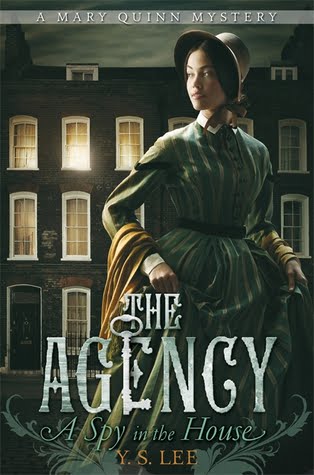
The Agency: A Spy in the House by Y.S. Lee

Continuing by recent YA binge, this book turned out to be a great Mid-century Victorian mystery set in.  The premise is nice: Mary, an orphaned thief, is rescued from the nurse and taken in by a charitable girls school.  The school's goal is to provide girls with an education that will give them better options for providing for themselves than marriage or menial service.  The Agency is an organization secretly attached to the Academy and staffed by female investigators. The book is well situated in its period and leaves lots of promising story threads to continue throughout the series.  I'm definitely eager to get my hands on the next couple books. Links: Y.S. Lee's website, especially check out the extras section!


Friday, July 20, 2012

Oh, Those YA Trilogies

Yes, I've been sucked in by another one, darn it.  They're just so tempting, but they leave me feeling a little like this (you know you want to click that link. Click it!). Nothing like a cliffhanger to torture you until the next book release. You know those YA books that make you want to grab the next person you see and shake them until they pick it up and read (no? You don't do that?). Well, anyway, Daughter of Smoke and Bone is kind of like that.

The Basics
Taylor, Laini. Daughter of Smoke and Bone. New York: Little, Brown and Co., 2011. Print

Laini Taylor lives in Portland with her husband, an illustrator, and their daughter Clementine. She's written several Young Adult novels already and was a finalist for the National Book Award.  Her credentials? Writer of fantastical fiction for teens and not so grown up grownups and possessor of pink hair. (I mean, pink hair, come on!).

The Book
There's so much to love in this book, but let's start with the best: it's utterly captivating. Taylor's writing style, the setting, the world crafting, the originality... the list goes on.

As always with fantasy fiction, the thing I'm most impressed by (or let down by if it doesn't work out) is the author's ability at world building. I want world that I can get lost in, and Taylor more than rises to the challenge. The world she creates is rich and highly detailed.  From the moment she drops us into the streets of Prague with Karou, our heroine, we become immersed in the world. She flawlessly crafts her setting, grabbing readers and pulling them without allowing them to pinpoint the mechanics of it.  But it's not just Taylor's settings that are so engaging.  The chimaera and seraphim that Karou interacts with are so incredibly detailed I feel like they might be real.  The teeth for wishes exchange system that dominates the first 1/3 of the book is original and interesting.  The world of the chimaera and angels is detailed by race, culture, customs, war, language. I feel like Taylor might have a compendium of backstory to go along with it; you can sense the depth that this story is built on, and that makes it that much more fascinating.

The chimaera are also amazing.  The number of combinations Taylor comes up with is great. And she describes these "monsters" with such vivid detail that you feel like they might really exist.  I can't wait to see what Taylor will do with the chimaera in the later books. I really hope that she's able to bring a couple more the forefront. Brimstone and friends are in the spotlight, but the depth of character they reveal is limited to what we can get when following Karou's perspective.  We start to get hints of more as the backstory fills out toward the end, but I want more.  And, really, that's the surest sign of a good story when it leaves you wanting more.

I can't wait to see what Taylor does next with series.  The book ended with a bit of a cliffhanger, though not too bad of one.  (My tolerance for that sort of thing is rather low). There's plenty of room for this series to grow.

Extras
 

Thursday, June 21, 2012

Classy Classics: The Witch of Blackbird Pond

That's right, it's time for another classic literature post.  Tonight's topic? The Witch of Blackbird Pond, a classic children's book.  I've loved this book since I first read it age 10. A chronic re-reader, I surpassed even my norm as a child by picking this book up 3-4 times a year until I was about 14. And, here's why you need to pick it up, too.

The Basics
Speare, Elizabeth George. The Witch of Blackbird Pond. Boston: Houghton Mifflin Harcourt, 1958. eBook.

Elizabeth George Speare was born 1908 and passed away in 1994.  She well known for her children's historical fiction and has won two Newbery Medals, on of which was awarded to The Witch of Blackbird Pond.

The Witch of Blackbird Pond follows the heroine, Kit Tyler, as she arrives in America from Barbados.  Following the death of her grandfather, she goes to live with her mother's sister in the Puritan colony of Wethersfield.  Her new life is a far cry from the freedom and luxury she enjoyed in Barbados. As Kit struggles to adapt, she also grows from an impulsive and rebellious girl into a confident and poised young woman.

Why You Should Read This Book!
I think the part of the book that first gripped me was the historic setting Speare uses. She places her story in Puritan American around the time of the Salem witch trials.  I loved history as a child, seeing it as one big story, so books that pulled from a historic background were always fascinating.  Speare does an excellent job capturing the feel of the period.  Readers can see the Puritan setting taking shape not just in front of them but around them, that's how immersive Speare's tale is.  The people Kit finds herself living with are as alien to modern readers as they are for Kit herself, which makes it incredibly easy to empathize and connect with Kit as a character.  This in turn further immerses the reader in the story, which is told in third person and focuses on Kit.

Speaking of Kit, the characters in the book are fantastically written. By the end of the novel, you'll feel as if you know them.  Kit, especially, feels like an old friend, since she is so easy to identify with.  Anyone who's every felt the least bit like an outcast will love her all the more.  She's bright, spunky, and incredibly out of place. But even the side characters are fascinating.  I was always partial to Kit's cousins, Judith and Mercy.  I'm not sure why I liked Judith so much a child, since she's clearly set up as a counterpoint to Kit. But, even when she's being snotty, you still have to like Judith who isn't ever really bad.  Mercy is sweet, and you'll find yourself quietly rooting for her as you read. Even the difficult characters are multi-faceted enough to find a likable trait. The only character who's truly detestable is the villainous Goodwife Cruff, as it should be.

Then we have Speare's fantastic story telling in general. From the start you'll find yourself invested in Kit's life and its outcomes.  You'll root for her as she defies prejudice and befriends the lonely old Quaker woman forced to live on the outskirts of town, bite your fingernails as she faces down accusations of witchcraft, and rejoice as she chooses a suitor and settles into a life of her own making. But ultimately, the story is not about any of those exciting events: it's about Kit, her daily life in Puritan New England and her journey toward womanhood.  It's warm and engaging and will keep you turning pages as quickly as you can.

Extras

  • There's not really much to share, but you find a picture of the author on the right.
  • And below you'll find a collection of various book covers.


Thursday, June 14, 2012

Orphans, Princes, and Plots, Oh My!

Writing my last post on teen summer reading really got in the mood for a nice Young Adult fantasy novel.  Sadly my initial pick was something of a downer, especially since the author shares my hometown (Boo on poorly written teen romance).  Then, my coworker (and Young Adult librarian, go figure), who I had hooked on The Thief series, handed me The False Prince and told me to give it a try.  It was awesome.

The Basics
Nielsen, Jennifer. The False Prince. New York: Scholastic, P., 2012. Print.

Born and raised in Utah, Jennifer Nielsen began writing as early as elementary school. She started out writing adult romantic suspense (I'm sure not in elementary school), before mobing on to fantasy novels for juvenile and young adult readers. She lives with her husband, three children, a dog, and a love of chocolate.

The False Prince is the first novel in Nielsen's new Ascendence Trilogy. Sage, an orphan and thief, is one of four boys selected by a nobleman to participate in a plot to install a false prince on the throne of medieval Carthya.  Sage must compete w/ the other orphans, and he's clearly competing for more than a crown, since the losing boys likely won't survive not being selected.  Sage stands a pretty good chance since he's clever, crafty, and a whole lot more than he seems.

The Book
One of the best aspects of The False Prince is that the book is incredibly well written. Nielsen offers up some high quality prose that is sure to please a wide audience.  It's not to advanced for her target teen readership, but it's sophisticated enough to engage and delight adult readers as well.  Along with the polished writing, we find a fast-paced and captivating plot that, while not entirely unpredictable, is highly interesting and extremely well done.  I can't say too much more without giving away all the good parts. Suffice it to say that I loved every second of the 342 pages that I breezed through in one evening (okay and very early morning).

Nielsen also provides readers with some great characters.  Until you get close to the end, you really won't be sure who to dislike and who not to worry about, which is nicely representative of the situation the protagonist finds himself in.  We have the conniving nobleman Conner, who is despicable but also frighteningly convincing in his manipulations.  Then we have the orphans themselves, who cover a range of personality traits: sickly, sniveling, brown-nosing, plotting, jerky, arrogant, in need of protection, sympathetic, clever, crafty, etc.  Given the short time period of the book (about 2 weeks) and the close quarters setting in which most of it takes place, the characters have to vivid to hold reader's attention. Nielsen more than succeeds at this.

The best part of the novel for me hands down was the level of suspense that Nielsen creates and maintains.  I could not stop turning the pages.  The novel is full of politics and twists, and it doesn't shy away from the occasional truly gritty scene.  A real, almost tangible sense of danger, importance, and urgency pervades the book, keeping both the characters and the readers on their toes.  Nielsen offers just enough hints and plotting to keep you guessing without allowing you to be absolutely sure of the resolution until its right up on you.  Perfect.

I'm dreadfully sick of the YA trilogy format that seems to pervade the age group regardless of whether the story deserves to be that lengthy. But this book made me love it again. I cannot wait for the second and third novels.

Extras
  • Visit the author's website for some nifty information and to check out her other series geared toward middle graders.  While you're there, also visit her section offering tips for writers
  • Nielsen also has a blog!
  • Check out The False Prince page over at the publisher's website, which offers a description and an excerpt. 
   

Thursday, June 7, 2012

What?! You Want Me to Read this Summer?

What with an A/C unit being down and the sudden abundance of teens skulking about the Library, I can really tell that summer has descended upon us yet again.  And I really mean descended, cause here in the South the heat and humidity kind of hit you with a whomp.  So what do you do with that youngster driving you nuts for the next 3 months?  Well, I've put together a slightly different blog post today and created a Summer Reading Recommendation List for teens (and maybe a few pre-teens/ advanced readers).  Now, these aren't your summer reading school books (blegh); these are books that I loved or would have loved as a teen.  Maybe you'll find a few on here that you or the teen in your life will enjoy.

And... List!

The Black Swan by Mercedes Lackey - This is a pretty good step-up book for teens into the realm of adult level material. This is one of my all time favorite fantasy books. It takes the tale of Swan Lake and transforms it into a complex story of torn loyalties.  Filled with strong characters and lush descriptions, it's got drama, romance, magic, and action, lending it wide appeal.

Count of Monte Cristo by Alexandre Dumas - This makes for a great read for teens.  It's got drama, suspense, betrayal and a hero you can really root for.  The story is fascinating, which makes it easier for teens to adapt to the prose and get into the book. Simple summary? The hero is falsely accused of treason, escapes from prison and seeks revenge against those who wronged him. Great classic read.

Croak by Gina Damico - I really loved this book. It's a recent release, so it's nice and fresh and likely something you haven't encounter just yet.  The heroine is nice and spunky with just the right amount of rebellion.  Oh, and she's a grim reaper, so yeah. Check out my full review or pick it up and get going! The sequel, Scorch, is due out this September.

Emma by Jane Austen -  Another classic that's great for teens. The prose is a little more difficult than Dumas, but its a great book for that a dip into classic literature. Emma is a great heroine, who, even through the divide of a couple centuries, teen girls can identify with.  You'll root for her and you'll want to smack her silly.

Enchanted Forest Chronicles by Patricia C. Wrede - The books are, in order, Dealing with Dragons, Searching for Dragons, Calling on Dragons, and Talking to Dragons. These feature a strong heroine who's not exactly your typical princess, dragons that aren't exactly fire breathing monsters, and  a good dose of humor in case you were worried about dragons and princesses getting too serious.

Ender's Game by Orson Scott Card - Originally written for an adult sci-fi audience, I think this books is great for teens. It's hero, Ender, is a young boy who lives in a futuristic world where the government breeds and relies on child geniuses to help combat a alien race set to destroy humans.  Ender excels at the school but also suffers from isolation as a result, making him easily identifiable.

Green Rider by Kristen Britain - I think I first picked this up at age 14. Again, it's not really written for a teen audience, but it translates really well.  The heroine starts out a 16 year old girl who runs away from her private school. Along the way home, she encounters a dying member of the king's messenger service who makes her promise to see to it that his life or death message gets delivered. Karrigan starts a school girl but grows up over the course of the book and the series. The other books are First Rider's Call, The High King's Tomb, and Blackveil.

Inda by Sherwood Smith - Smith has written for the young adult audience, but this book targets adults. It is significantly more adult in some of its themes, but for an advanced teen reader, I think it could work.  The story follows Inda, the second son of a nobleman, who is sent to the Royal Academy to be trained in battle and leadership.  This also tosses Inda into a world of intrigue and advanced politics, which he only begins to understand by the end of the novel.  Continue with The Fox, King's Shield, and Treason's Shore.

Maus I and II by Art Speigelman - Don't knock the graphic novel. This one is a true literary work of art.  It tells the story of the author's father's experience during World War II on the run in Hitler's Europe.  In the novel Nazis are portrayed as cats and Jews as mice with a variety of symbolic animals mixed in for other groups and ethnicities. A moving true story that will absorb any reader, with a richness added by the illustrations.

Quest for a Maid by Frances Mary Hendry - I'm pretty sure this was in my stocking one year, and, like the perverse teen that I was, I refused to read it for a while before a fit of boredom took hold. It soon became a favorite.  This is more middle school age level, but worth a read all the same. Hiding under a table, Meg hears her older sister Inge murder the King of Scotland with witchcraft. Meg is sent to accompany the rightful heir, The Maid of Norway, back to Scotland. Adventure ensues.  A great historical novel set in medieval Scotland.

Ranger's Apprentice by John Flanagan - I've posted on this in the past, but I must reiterate how excellent these books are. Great for boys and girls alike, this series can also be a gateway into reading for a reluctant reader.  They follow Will as he journeys from apprentice to full Ranger. Rangers are part of a peace keeping force that protects the nation from both inside and outside threats and are known for their skills at archery and sneakiness.  Start with The Ruins of Gorlan and move on to The Burning Bridge, The Icebound Land, Battle for Skandia, The Sorcerer in the North, The Siege of Macindaw, Erak's Ransom, The King's of Clonmel, Halt's Peril, The Emperor of Nihon-ja, and The Lost Stories. That should keep you occupied for awhile.

Ready Player One by Ernest Cline - Video gamer? Get old school with this great historical gaming read. And by historical, I mean the 80s.  This novel is set in a dystopic modernity that has retreated to a virtual world. Players the world over seek out clues that will eventually lead them to "win" an inheritance, and Wade Watts aka Parzival finds the first clue. See my previous review for more details.

The Scarlet Pimpernel by Baroness Emmuska Orczy - I love, love, loved this book as a teen.  It's set during the French Revolution and features a historical caped crusader who rescues french nobility from Madame Guillotine.  It's a classic, but the story is so riveting it's easy to get into.  It's filled with suspense, drama, intrigue and action, with just the right dash of romance.

Tailchaser's Song by Tad Williams - another foray into adult level material. It tells the story of Fritti Tailchaser, a tom cat on a mission. It's a fantasy told from a cats perspective.  Guaranteed to be a hit with animal and adventure lovers alike. And don't make the mistake of comparing it to Erin Hunter's Warriors series. It's so much better.

The Thief by Megan Whalen Turner - This is a great series starter that focuses on Gen, a mischievous thief who gets somewhat unwillingly drafted by the King's Scholar into a mission for an ancient artifact. Still, it's better than prison; the magus might have a plan, but Gen is tricky and has some ideas of his own. This book is a lot more complex than it initially appears to be with all politics, mythology, and some really great complex characters.  Once you're done with this one, move on to the rest of the series: The Queen of Attolia, The King of Attolia, and A Conspiracy of Kings. The twist in the second book will get you.

Books I haven't read but will cause I'm pretty sure they're awesome


Cinder by Marissa Meyer -  a retelling of Cinderella with a futuristic cyborg twist.
Daughter of Smoke and Bone by Laini Taylor - a young girl lives half in a world of monster, runs mysterious errands and searches for the truth about herself.
Graceling by Kristin Cashore - Gracelings are gifted with extreme skills, and Katsa's grace is killer, literally. Made to act as the king's bullyboy, she befriends Prince Po, learns a pretty important secret, and embarks on an adventure.
Terrier by Tamora Pierce - Beka Cooper is a rookie police officer, known as Terriers, who wants to be at the top of her profession.


Thursday, March 29, 2012

Why Don't You Just Go... Croak?

So if I was really super awesomely on top of things, I would have read this book in time to post last week. Cause then it would have been even newer. But, I'm not; I read things as they catch my fancy. Still 9 days after the release date isn't bad, right? (Someday, I'll be super-awesome-blogger girl and get Galleys for this. *nods head*).  Tonight's post spotlights the very fun, fresh, and epically awesome new Young Adult book, Croak.

The Basics
Damico, Gina. Croak. Boston: Houghton Mifflin Harcourt, 2012. eBook.

Damico does not yet have a wikipedia page or any other info out in the easily searchable interwebs, so this bio is solely based on the much better one found on her website (See Extras below).  Damico is from New York state and holds a degree in theater and sociology. She currently resides in Boston with her two cats and a husband (Sebastian informs me via claw that cats take precedence). Croak is her first novel of epic awesomeness; I'm sure there will be more to come.

Croak's heroine is a girl named Lex, who's "troubled." She kicks, spits, punches, and terrorizes the school hockey team (and generally everyone else).  So, her parents, at their wits' end, ship her off to her Uncle Mort in upstate New York to spend the summer working on his farm. Except he's not a farmer, he's a Grim Reaper, and so is Lex. Sarcasm, antics, and drama ensue.

The Book
Is awesome.

Okay, so I've got more to say than that.  Let's start with Lex.  She starts out as a surly, angry teenager, who's pretty thoroughly unlikeable.  She picks the hair of a kid she bit out of her teeth with a "quick snap" like a proper little psycho.  However, Lex grows on you pretty quickly (in a decidedly un-fungus-like manner, too).  Since the entire third person narrative follows Lex, you get inside her head pretty quickly.  You learn that she doesn't really understand her own behavior any better than her baffled family, and I think that's something that normal (non Grim Reaper) teens can easily identify with  (I mean really, it's a miracle any of us survive that age without being strangled), even if the excuse of being hormone addled is far less cool. You also get to watch Lex grow a bit and start to come into her own as she finds a place where she can be herself in Croak.  She's also a sarcastic little smartie-pants, which makes for fun reading.

And speaking of sarcastically delightful reading, Damico infuses Croak with a delicious sense of humor that produces laughs with almost every page.  I actually had to share the laughs and read a passage out loud when she encounters a frat boy with a popped collar who "resembled a preppy Count Chocula" and "put on his best 'I'm a douchebag' face'," right before calling her cutie.  Hi-larious! Best of all, it's a kind of humor that I think really resonates with the audience that Damico is targeting. And it's highly quotable, too; I will long hold fond memories of the phrase "it's a bedroom, not a Victoria's Secret".  At times it borders on the farcical and the ridiculous (almost cartoonish), such as when Teddy Roosevelt roars at Edgar Allan Poe who in turn screams like a little girl.  But this will 1) help it appeal to a broader age range, dipping into slightly younger groups and 2) provoke thought about the nature of death and the afterlife via humor. (Right? Totally).

And let's not ignore the fact that in addition to being hysterically funny, Damico's writing is just plain good.  She delves into some fairly interesting subject material: life, death, the nature of the afterlife, justice, family, belonging, loss, grief, responsibility.  And that's just what I can think of in the matter of a few seconds; I'm sure I could go on.  There's a lot for the mind to chew on in between all the wise-cracks; I know it was pretty thought-provoking for me.  I think that especially for the young adult audience, this particular take on death could prove interesting. I know that nothing mystified me more as a teen than the idea that someone could be there one second and gone the next. It still does.

Best of all, Damico is carving out new and interesting territory for herself in the realm of Young Adult fiction. There's not a dystopia, vampire, angel, werewolf, or wizard in sight.  Grim Reapers aren't exactly a new idea (there was the show Dead Like Me a few years back and probably other stuff), but Damico takes this to a new and exciting place.  And she does it very well, I can't wait for more.

P.S. Don't listen to reviews that whine about the pace of the ending. It was not sudden. It flowed well and made perfect sense within the happenings of the book. Nyah, so there.

Extras
  • So, go check out Gina Damico's webpage for plenty of snarky goodness! There's a cute video trailer for the novel if you scroll down to the very bottom. And don't forget to check out the bio!
  • While you're there, check out her blog, especially her latest post that could lead to a deleted scene from Croak if you play your cards right.
  • The sequel (Squeeeeeee!)? Yeah, it comes out in Fall and stuff. (Spoiler Alert: Do NOT read the summary for this book or you'll ruin the ending of Croak for yourself. You have been warned).
   

Thursday, February 16, 2012

Classy Classics: Anne of Green Gables

In my rebound from The Hunger Games, I picked up L.M. Montgomery's Anne of Green Gables and its sequels.  Like many girls who pick up these books, I loved Anne from the moment I met her.  And I love her still more now.   These are great reads for young girls and adults alike, so let me show you why you should pick up this classic series if you haven't already. (Yes, I know I tend to migrate toward girly classics, but I assure you I've got tons more with wider appeal to pull from my bag of tricks).

The Basics
Lucy Maud Montgomery was born on Prince Edward Island in Canada in 1874.  She began publishing short stories in 1897.  She first published Anne of Green Gables in 1908, but didn't complete all installments in the series until 1839.

Like Montgomery, Anne grows up on Prince Edward Island.  The series opens with Anne Shirley's adoption by Matthew and Marilla Cuthbert, an older brother and sister, who initially mean to take in a little boy to help with the farm work.  Anne quickly wins their hearts with her imagination and sweet nature.  The series follows Anne from the moment of her adoption into adulthood; along the way readers watch Anne grow into a young woman, get an education, find love, settle down, and become a mother. The books are, in order (though not order of publication), Anne of Green Gables, Anne of Avonlea, Anne of the Island, Anne of Windy Poplars, Anne's House of Dreams, Anne of Ingleside, Rainbow Valley, Rilla of Ingleside.

Why You Should Read These Books
I guess I can hardly avoid starting off with our titular heroine Anne.  Anne is unlike any other character. She's full of life and so vividly drawn I feel as if she must have been real.  As a young girl, I identified very much with Anne and her vibrant imagination full of fairies and a love of nature.  It also helped that she had an enormous (and hilarious) capacity for getting herself into "scrapes." Whether she's dying her hair green, falling from rooftops, or extolling the loveliness of a tree in bloom, Anne can't fail to warm your heart. (Unless, of course, you don't have one.  You do have one, right?). One of the best parts about the series when you're reading it as a young girl is that you can almost grow up alongside Anne.  And, when you revisit the books at a later date a new stage in Anne's life will have opened up to your further understanding, meaning that whatever your age, you can identify with the heroine.

You really can't beat L.M. Montgomery on her prose.  Her style is warm and engaging, at times hilarious and at others tear jerking depending on what a scene calls for. There's a certain genuineness to Montgomery's writing that engages readers' emotions as well as their interest.  I also really appreciate her versatility in tone.  Much of each book is dedicated to simple, everyday Canadian life around the turn of the century, and Montgomery imbues these scenes with a level of realism that pulls me in so much that I feel I might look up at any moment and be surrounded by Avonlea.  At the same time, Montgomery is capable of some of the most florid flights of fantasy, experienced most often when Anne freely indulges her powerful imagination.  Believe me, you'll never get bored.

A unique aspect of the books that I enjoy is that the plot of each novel is wholly focused on Anne's life stages and her passage through them.  There are many little plot threads that run throughout each book, but there isn't really a dramatic overarching plot line like you see with most (if not all) series today.  The books are truly character driven rather than plot driven in a way that is rare today where readers demand a defined story to follow.  I like the meandering snapshots we get of Anne's life; it's nice to read something just a little bit different and less modern.  As a result, the Anne books make for quick, light hearted reads that will nevertheless leave a lasting impression.

Extras

L.M. Montgomery

   Pin It

Thursday, February 9, 2012

Hungry for More

That's right, I gave in.  I finally read The Hunger Games. I've resisted the book for so long, but gradually my interest peaked until I could no longer ignore the book (this process of slow-moving obsession to near constant trailer watching delights my boyfriend to no end).  Why would I not want to read it? (I can practically feel the ravening hordes of fans circling). I think Margaret Atwood first ruined dystopias for me; they're not exactly happy-fun times.  And even though I loved The Hunger Games, reading it in less than 48 hours, I still think dystopias suck.  That's when I pinpointed my problem: dystopias seem too probable and that scares the hell out of me. But enough about my deep seated psychological issues and whining, let me tell you how absolutely awesome The Hunger Games really was.

The Basics
Collins, Suzanne. The Hunger Games. New York: Scholastic Inc., 2009. Print.

Before she wrote epically awesome books, Collins wrote for children's television; she was partially responsible for Clarissa Explains It All for crying out loud! And before she moved on to Katniss, Collins authored the best-selling series The Underland Chronicles.

The Hunger Games takes place in a dystopian, post-apocalyptic North America, known as Panem.  Following a rebellion, the ruling body in the Capitol forces each of the twelve districts to participate in the titular Hunger Games.  Each district sends a male and female tribute between the ages of 12 and 18 to participate in a televised (and glamorized) fight to the death.  For the Capitol this is great entertainment, while for most of the districts it's a death sentence.  The story follows the heroine, Katniss, during her fight for survival in the Games.

The Book
So, I realize that for a lot of people, my review is about like saying that the Harry Potter books are pretty good, but I also think there are plenty of people out there who still need to pick up these books.  This review is for them (my own brother had never heard of the books!).

(Crud, now I have to put this book into words).  Okay.  I can do this.  The best part of the book was Katniss, which is a pretty good thing since the whole novel is from her point of view.  I like the strength of her character, from her intellect and creativity to her will to survive.  Even when she's irritatingly oblivious (poor Peeta), I still like her.  Even in her flaws, Katniss is very much a product of her world and the situations into which she's thrust.  Why would she think about such frivolities as love and pretty clothing when she has larger concerns such as starvation and seemingly imminent death to dwell on? It helps that she's highly sympathetic, which makes it easy for readers to identify with and root for her. Her excellent narration pulls readers into her story; I found myself raging against the injustice of the Capitol right along with her.  I was glad to see the strength, intelligence and over-all quality of her character, given how many young girls adore her (better than some other books I can name...).

As always for me in the fantasy genre, the world-building aspect of the book holds a lot of appeal.  Collins does an excellent job creating Panem.  The harshness of the world is emphasized by the manner in which readers experience it.  We are instantly immersed in the world since we see everything through Katniss, whose place in life is already pretty well established.  Readers learn about Panem as they follow Katniss either through observation and context clues or through Katniss's musings.  Despite the harsh dystopic condition of the country, I couldn't help but be fascinated with its traditions, politics, and just general goings-on.

And then we have the Games themselves, which I found as fascinating as they were horribly barbaric.  Being something of myth buff, I could see the connection to the Theseus myth Collins claims as inspiration, but her story is so much more than that (and, you know, lacking in minotaurs). The trappings that surround the games, making them into a form of entertainment to the people of the Capitol are intriguing (and, well, entertaining) but at the same time draw attention to the stark contrast between spectator and competitor.  Collins does a great job crafting memorable characters to surround Katniss during her time in the Games from her support team to her often nameless enemies (quite a feat to have memorable nameless characters).  Collins also creates a realistic and immersive vision of the survivalist Games.  She doesn't ignore Katniss and the other tribute's need to provide themselves with food and water and the physical effects of failing to do so in favor of describing the action and gore of the Games.  Nor does she simply represent a glamorized, stylized form of violence; her representation is realistically gritty (and occasionally pus-filled).

It's this skillfully crafted combination of imagination and realism that will keep readers turning pages.  And really, if you haven't read The Hunger Games yet (or, heaven forfend, not heard of it) go pick up this book now! (Go on, shoo). I absolutely loved the novel and can't wait to read more. That being said, I had originally planned to read through the whole trilogy before writing this blog post.  Instead, I'm taking a break; Katniss's world is just too intense.  I get downright surly as I empathize with her plight. So, I think I'll take a break and escape into an old, light-hearted favorite, Anne of Green Gables; that's about as opposite as it gets right?

Extras
  • As always, I must point you to the author's website, where you'll find additional info on the author and her other series.
  • Scholastic, the publisher, has a fairly nifty site for the series, including some entertaining little The Hunger Games inspired games to play.
  • And, unless you live under a rock, you might have heard that there's a movie, whose trailer can be found at the official website, starring the superb Jennifer Lawrence.


    Pin It

Thursday, December 15, 2011

Classy Classics

In today's post, I'm doing something a little different than my usual book review.  Today, I'm posting on a book that's considered a classic. Naturally, such a title hardly requires a review; if it did it wouldn't be considered a classic in the first place (like, duh).  This classics post focuses on Louisa May Alcott's Little Women, which was one of my favorite books as a teen and remains so today.  I also associate the book with the holiday season, perhaps because the book begins at this time of year.  Regardless, this is my happy feels book I read almost annually (I really need to break down and buy a nice hardcopy; I've been through 3 paperbacks by now).

The Basics
Alcott, Louisa May. Little Women. New York: Signet Classic, 2004. Print.

Little Women follows the lives of the four March sisters: Meg, Jo, Beth, and Amy. The  girls are 16, 15, 13, and 12 respectively when the book opens, and readers shadow the girls through their teen years as they become young women.  Much of the story is based on Alcott's real life experiences with her own sisters, so it makes sense that the books seem to focus largely on Jo March (the character most closely resembling Alcott). However, the novel does often divert from Jo in order to tell the stories of the other sisters to the fullest.  The book is a heartwarmingly wholesome story for young girls that pulls readers delightfully into the 1860s American household in Concord, Massachusetts. 

Why You Should Read this Book (and/or force it on the nearest young adult)
One of the best features of the novel is its focus on overcoming struggles that life presents and bettering yourself along the way.  Though by no means poverty stricken, the March family has fallen on harder economic times after one of their father's investments goes south.  This puts the girls in the odd position of being in an upper class family without the means to reflect that status. They also face the hardship of being without their father, who has joined the Union army as a chaplain. This leaves the girls, along with the stalwart Ms. March, to run the household themselves. The March girls face these challenges as well as the challenges of their own individual personality flaws as they work to become the best "little women" possible (as patronizing as that phrase can sound, I think this novel means it more as the start to womanhood than anything else).  The books is full of little successes and joys as well as hard times and tragedies, making it a well-rounded, engagingly realistic read.

Little Women is almost entirely character driven. While it has little plot points that occur throughout the novel and a few larger (if more subtle) ones that unite the story as a whole, Little Women is primarily centered on the everyday lives of its heroines.  Meg, the eldest, is a sweet tempered, beautiful girl on the cusp of womanhood. Meg most remembers the March family's former wealth, and her desire to return to that former status combined with her vanity is her biggest struggle.  She must resist the trappings of a wealthy life that would only make her materially happy.  Jo is tomboyish and a little wild with aspirations to become a great writer and avoid becoming a young lady as long as possible. Over the course of the novel Jo works to overcome her more imprudent spontaneity and her hot temper.  Beth is the sweetest, kindest of the March girls, but she is also painfully shy and fearful of strangers.  Her challenge in life is to overcome her shyness enough to make friends and accept kind overtures.  She also faces her own sickly constitution, which she handles with a grace and infinite patience that inspires her sisters to better themselves.  Amy is slightly spoiled, very vain and proud, and somewhat inclined toward selfishness; however, she also has a sweet an loving nature. The first half of the novel sees Amy work to overcome the selfish parts of her nature and begin thinking more of others than of herself.  In the latter half, Amy gradually turns her vanity and pride into being a proper young lady. It's nearly impossible not to like and identify with Alcott's characters.

I also really enjoy the sense of the period that the book provides.  Readers are exposed to a charming  19th century New England that nevertheless maintains a sense of realism.  Through the girls, readers are exposed to ideas of dress, propriety, class and religion common to the era.  You also get a strong sense of womanhood in the period (albeit a specific class level), as well as common activities, socializing and the important role marriage played in a young girl's life.  Along with your enjoyable read, you also get a small slice of history if you're clever enough to notice it.

Extras