Showing posts with label series. Show all posts

Thursday, May 31, 2012

Plum Awesome

I've finally gotten around to reading another series I've been meaning to sink my teeth into.  A while back I reviewed Wicked Appetite by Janet Evanovich (The sequel is out this June.  Excited!), and it completely hooked me on Evanovich's writing style.  So, I figured I'd read Stephanie Plum next, who brought Evanovich success in the first place. I went in expecting to enjoy One for the Money, and I did. But the novel took all my other expectations, stomped on them a couple times, kicked them in the ribs, and showed me how much better it could really be.

The Basics
I've already told you a bit about Ms. Evanovich's writing in my previous post, but here's bit more about her for kicks.  Evanovich grew up in New Jersey; she was a second-generation American and the first in her family to attend college. She currently resides in New Hampshire with her husband, and according to her bio wants to be like Grandma Mazur when she grows up (read this first book and you'll see why).

One for the Money is the first book in the Stephanie Plum series, featuring none other than Stephanie Plum. Stephanie is a down on her luck ex-discount lingerie buyer from blue collar New Jersey.  While her mother thinks she needs a new husband, Stephanie knows she needs a job. Fortunately her reluctant and perverted cousin Vinnie is a bail bondsmen, and she blackmails him into taking her on as a bounty hunter. Her first target? Joe Morelli, a cop who skipped out on bail for murder.

The Book
Sadly I had already seen the movie before I read the book. Not that the movie wasn't enjoyable, but this is a mystery book, so I went in mostly knowing what happened. That being said, I'm really looking forward to the second book, when I can experience the mysterious part of the mystery.  Evanovich weaves a really good tale and lays all the investigative work out for her readers.  I can easily see myself solving things along with (and hopefully slightly ahead of) Stephanie. Evanovich creates nicely complex story lines with lots of interconnected details and red herring or two.

I also really liked her characters.  She crafts believable human beings with just the right hint of ridiculousness.  My favorite books are those that are full of humor, and the way Evanovich incorporates that humor is genius. Rather than stuffing her characters into bizarre and goofy situations to create humor, she makes the characters themselves funny.  It's the characters and their actions and reactions that make the story amusing.  So whether Stephanie hops the curb to run over the guy who kissed and told or Grandma Mazur adopting hot pink shorts as a new fashion statement, the hilarity arises mostly from the people. Not that situational humor doesn't have its place. Evanovich balances the funny parts so nicely that you'll always be laughing and never thinking "Oh, please."

Speaking of balance, don't think that One for the Money is all giggles; Evanovich really goes for the whole cannoli (I should learn to make those...).  One of the elements that surprised me once I got into the novel was how gritty the story could become.  My previous Evanovich experience was a little more light and fluffy and cupcake filled than this, where the only cupcake we get is Morelli's nickname for Stephanie (nope. Cupcakes. I should make cupcakes Sunday).  Evanovich doesn't shy away from the more realistic and dangerous side of Stephanie's new bounty hunter gig.  The book has its share of blood, bruises, and psychos, and it will get your heart pounding as you root for Stephanie and bite your nails until you see her come through it alive but not unscathed.

You can also tell that Evanovich has a really feel for the New Jersey setting of her series.  Since she grew up there, I'd hope so.  As Stephanie navigates Trenton, we get a real sense of life in Jersey. Evanovich incorporates everything: the landscape, the people, the mannerisms, the turns of phrase, the culture.  The book doesn't just have a New Jersey setting; I feel like I'm breathing the (decidedly questionable) air as I read.  It's the difference between "oh, neat, they're in New Jersey" and imagining that if you look out your window you'll discover you've been transported to the burg.

Evanovich offers a well-rounded reading experience that's sure to delight. And, I highly recommend that you pick up this series.  Start with One for the Money and go from there; you'll have plenty to keep you occupied, since she's already up to 18.

Extras
  • Head on over to the author's website for lots of fun information and especially check out her Stuff for Fans section.
  • So, you might have heard that the first book got a movie.  Sadly it was widely panned by the critics so there likely won't be a second. I thought it was cute and that critics didn't like it cause it's hard to classify. Just don't expect high art and you'll enjoy.
  • Check out this fun Stephanie Plum website that lets you visit the Burg and play games. What's not to love?
  • And lastly, a photo of Janet Evanovich with doggie for your viewing pleasure.
 

Friday, April 13, 2012

Fantastic Fantasies: By The Sword

It occurred to me the other day when I was contemplating what book to post on next that I hadn't done, well, anything on a nice, classic high fantasy novel (we're talking Lord of the Rings, epic sword-swinging, magic-wielding stuff here).  These days I tend more toward the supernatural / urban fantasy side of the genre. But, that is a serious gap I mean to address, especially since high fantasy was a big part of my early reading life. One of the first adult level books I ever picked up was By the Sword by Mercedes Lackey.  I was hooked, and her Valdemar series became one of my most treasured escapes.

The Basics
Lackey, Mercedes. By the Sword. New York: DAW Books, 1991. Print.

Mercedes Lackey is a prolific author in the fantasy genre; seriously I'm not even going to try to delve into her oeuvre here (It's big; the end). She's also worked with some big names in the fantasy fiction world, like Piers Anthony, Marion Zimmer Bradley, Andre Norton, and Rosemary Edgehill to name a few.  She's active in bird rehabilitation, which is pretty cool, and she often writes lyrics and folk music that tie in with the fantasy world she creates.

The Valdemar series is by far her most heavily populated, spanning 30 novels, 7 short story collections, and a companion book. By the Sword was my introduction to this world and remains my favorite (not that that stopped me from dedicating a ton of shelf space to this series).  The book follows the life of Kerowyn as she journeys from daughter of a Keep lord, to apprentice sword-slinger, to mercenary and leader. Having rescued her brother's kidnapped bride, Kero becomes apprenticed (more or less) to the sword mistress, Tarma.  This sets her on the path to become a mercenary with the Skybolts, where she works her way up the ranks and eventually makes her way to Valdemar (home of talking horses, what's not to love!).

The Book
Now that I'm done boring you with my atrocious summary (it's so hard to summarize fantasies without them sounding really bad), let me tell you why you need to pick up this novel (and then the whole darn series). Let's start with Lackey's fantastic world-building skills.  Lackey has created a world that spans a continent rather than a country.  While many of the novels are set in Valdemar, others, like By the Sword pick up elsewhere. Her world is so well crafted that you can pick up a character in any given location and have it connect with the world of the other novels. She's also built an entire history to the world, so that the series spans time as well as geography. Each new novel adds a new layer of richness.  The result? A seamless fluidity that makes the world of Valdemar and Velgarth seem like a tangible reality, and the stories become that much more immersive.

To get more specific about By the Sword, we become immersed in vaguely medieval world, with sorceresses, keeps, nobility, and an enormous, intelligent, mind-speaking wolf (known as Warrl; he's a favorite). I especially like all the details that focus on sword-play, stealth, strategy and war that appear as we follow Kero in her career as mercenary. Plenty of fantasy novels have mercenaries, mention mercenaries or talk about mercenaries, but few focus so exclusively on them to the degree and depth that Lackey does in By the Sword. We get an up-close look at mercenaries in Lackey's world that includes their organization and operations. It makes for an interesting and different slice of the fantasy world.

But the best part of this particular book is Kero.  Lackey's novels tend to be very character driven, giving readers very well developed characters to get to know (and love).  In particular, Kero was my Katniss (minus the grumpy dystopia).  Kero is a strong, independent female character; she takes care of herself and others, is a great leader, and can totally kick ass if necessary. As a thirteen-year-old she was my hero, and I'm awfully fond of her still today. We watch her grow up from a teen who's not quite sure where she fits yet, to fierce warrior, to a superb leader that puts duty and her people first. Add a little adventure into the mix, and you'll love every second of it.

I highly recommend this novel and the series to fantasy lovers of all ages.  There's a little something for all tastes in Lackey's Valdemar books.

Extras


Thursday, March 1, 2012

Sate Your Wicked Appetite

So, I was looking for a book that would be a nice quick read this week.  I wanted to post on something other than the October Daye series, lest you guys get bored. I figured, "I'll go with a nice mystery, something by Janet Evanovich," who I've been meaning to read for a while now.  I darted over to the shelf while there were no patrons around and snatched up a copy of Wicked Appetite, because I'd heard its a) good and b) the start of a new series (you know I like my series).  While I succeeded in locating a quick read (we're talking under 24 hours here), I'm afraid I did not completely avoid the supernatural (sorry! *dodges tomatoes*).

The Basics
Evanovich, Janet. Wicked Appetite. New York: St. Martin's, 2010. Print.

Janet Evanovich began her authorial life writing romance novels under the pseudonym Steffie Hall.  However, she quickly realized the full force of her awesomeness and began writing under her own name. After a (pretty decent) number of romances, Evanovich transitioned into mystery writing, and aren't we all glad she did?  This move resulted in the creation of the light-hearted and ever-popular Stephanie Plum (keep her away from your car. No, really) a good 18 novels, and movie deal.

Wicked Appetite is one of Evanovich's more recent novels and is the first installment in her new Wicked series.  The book introduces a new heroine, Lizzy Tucker, and features an old friend, Diesel (who appeared in the Stephanie Plum between the numbers novellas).  The book continues Evanovich's trademark style mix of light-hearted chick-lit, mystery, kooky sidekicks, and outrageous humor as Lizzy and Diesel work together to track down the 7 SALAGIA stones that correspond with the seven deadly sins (and that's every bit as delightfully ridiculous as it sounds).

The Book
I loved this book and I have no difficulty in pinning down why: it was hilarious.  This novel was literally laugh-out-loud funny, something I rarely come across in my reading life.  I liked that it took me outside of my normal range of amusement, too; rather than the witty sarcasm I typically gravitate towards, Evanovich leans more toward straightforward and blatantly hilarious.  I can't begin to count the number of times she had me practically cackling aloud with glee (and incidentally, my boyfriend looking at me like I was a crazy person). I think a few examples are in order, yesh? To start, the opening of the novel and Lizzy's comparison of life to lumpy gravy (cause, you know, it's not all smooth) had me at hello. How can I resist a good food metaphor? (I can't, just fyi). Another favorite part: when Lizzy's Dad drops in for a visit and tells the monkey to "be a man... eat your potatoes!" Hilarious! (and I swear, it makes total sense when your reading the book).  This novel was a farcical bit of fun that had me grinning throughout and laughing through much.

And then, of course, there's Lizzy.  I love her.  She makes cupcakes. The end. Just kidding (about the end part, anyway; you're not getting rid of me that easy).  In addition to being a superb cook with a fabulous cookbook idea, Lizzy manages to be funny without being ditzy, which I love. I'd hate her if I thought she was stupid.  Instead she comes off as intelligent and relatable, and carries off the weirder moments with a grace and humor most ladies I know would kill to have.  And really, what's not to love about a girl who can laugh about falling off a toilet and breaking her nose by pointing out the bright side of getting a perfect schnoz out of the resulting corrective procedures? Another, favorite character: Lizzy's sidekick with witchy aspirations, Glo. She's a hoot.

I also enjoyed how speedy this read was. This is not because the book is overly simple, but rather due to Evanovich's snappy writing style.  She grabs readers' attention and doesn't let go; the book is so action packed and fast paced that you can't fail to be caught up in the whirlwind. I also think a lot of my absorption was due to the farcical style of the mystery; even the serious bits poke fun at themselves. There's an entire group of people that call themselves "Unmentionables" for crying out loud. I think if readers aren't expecting that or (worse) if that style of humor doesn't appeal, then they won't like the book at all, but I sure loved it.  There's so much to prasie, a blog post just can't contain it; I can't wait for the sequel.

Extras 
  • As always, I must point you to the author's website (gotta show the authors plenty of love. It's a rule. I know these things), including her nice bio.
  • Don't forget her page for Wicked Appetite, which includes a link to read the first chapter if you want a taste ahead of time.
  • For a glimpse at the sequel (see it's awesome cover!?), try the Wicked Business page. There's not much there yet, but there will be. Out June 19, 2012! (what? Excited? Me?).

   Pin It

Thursday, February 23, 2012

Parsley, Sage, Rosemary and... Rue?

Okay, so the title of the book I'm reviewing is actually taken from Shakespeare's Winter's Tale; I just can't resist cheesy one-liners for title.  What can I say? (Nothing, I have nothing to say for myself). This is one of the authors I caught on to from reading the short story compilation, Home Improvement. And so, for this evening's book review, I turn to Seanan McGuire's Rosemary and Rue.

The Basics
McGuire, Seanan. Rosemary and Rue. New York: DAW Books, 2009. Print.

McGuire was born in California and is the author of the October Daye and the InCryptid fantasy series. She's also a singer-songwriter, and, according to her official bio, has what seems to be an unhealthy propensity for being bitten.  But she also has three cats, so she's super in my book.

Rosemary and Rue is the first novel in the October Daye series of urban fantasies and was McGuire's debut. It's heroine, October "Toby" Daye is a changeling recovering from 14 years spent as a carp and is strongly resisting being pulled back into the realm of Faerie.  After being cursed by an old "friend" into solving said friend's murder, Toby is forced to return to her PI roots to find the killer before the curse kills her. (Duh duhn dunnnn).

The Book
I loved this book.  From the very moment I started reading, I was hooked.  McGuire's prose pulls readers in and doesn't let them go until it's good and well ready to. Told in first person from the perspective of the heroine, McGuire spins a tale both gritty and witty. There's a realism infused in her writing style that is ideal for the genre of urban fantasy; it captivates readers by creating a sense that this could actually be happening out on the streets. (Maybe right now. Maybe... behind you!). If you can suspend your disbelief for just long enough, the story will draw you in and do the rest of the work (and really, what are you doing reading fantasy novels if you can't suspend your disbelief).

I also liked that this novel was firmly situated in the genre of urban fantasy: heavy on the paranormal, light on the romance.  If you pick this book up expecting paranormal romance, you're going to be sadly disappointed.  This is a noirish little mystery. And, while I'll totally be down for Toby to get a little romantic action in the future, I hope that the books stay largely true to this feel.  (Give me early Anita Blake, please, and take your erotica elsewhere). The book is chock full of the Faerie realm, pulling from so many Fae traditions that readers can't get bored; and it's all rooted in modern-day San Francisco.  All the tiny details, McGuire adds about the Fae and their lives, etc adds to the sense that there might be an entire world waiting for readers just around that corner.  Yep, it's awesome.

Toby is great fun as a heroine.  She's cheeky, but intelligently so. She mouths off frequently, but she tempers that with a sense of timing, controlling herself when it's wise to do so.  I really like that balance, since the witty, take-no-prisoners heroine is becoming a commonplace figure.  The balance McGuire strikes with Toby is different from other main characters who often mouth off without thought to the consequences. While this may make them look cool for all of two seconds, I almost always find myself displeased with how they get away with it, breaking my focus on the story.

Nor does Toby have or acquire all the answers easily.  Even if she's supposed to be good at finding answers, she's convincingly off kilter, having been out of the world of Faerie for the last 14 1/2 years. I think I had the mystery figured out slightly ahead of Toby, maybe 3/5 of the way through the book and I was sure, but I think part of that was that the truth was so unpalatable for her.  I'm really excited to pick up the next novel, and look forward to seeing Toby a little more on her game.

While I was researching this book, I noticed that a lot of readers had been disappointed by how much Toby gets tossed around in this book (but how well would you handle a thug shooting at you? Hmmmm.).  But, I liked that Toby isn't much of a fighter; she does what she has to to survive, but mostly relies on her ability to solve problems.  The urban fantasy genre is saturated with heroines that kick butt and take names; it's nice to have one around who relies firmly on her wits.

McGuire has carved out a refreshing little plot of land in the realm of urban fantasy for her series, and I can't wait to immerse myself in it further!

Extras
Toby? Are you down there?
  • Here's that official biography I mentioned over on Seanan McGuire's official website, which also features some online fiction she's written.
  • While you're there, check out the Toby Daye FAQ page, if nothing else.
  • In case you're unfamiliar with Golden Gate Park (The De Young Museum and Conservatory of Flowers are awesome, btw), here's a link to the Japanese Tea Gardens, featured so prominently in the book.

    Pin It

Thursday, February 16, 2012

Classy Classics: Anne of Green Gables

In my rebound from The Hunger Games, I picked up L.M. Montgomery's Anne of Green Gables and its sequels.  Like many girls who pick up these books, I loved Anne from the moment I met her.  And I love her still more now.   These are great reads for young girls and adults alike, so let me show you why you should pick up this classic series if you haven't already. (Yes, I know I tend to migrate toward girly classics, but I assure you I've got tons more with wider appeal to pull from my bag of tricks).

The Basics
Lucy Maud Montgomery was born on Prince Edward Island in Canada in 1874.  She began publishing short stories in 1897.  She first published Anne of Green Gables in 1908, but didn't complete all installments in the series until 1839.

Like Montgomery, Anne grows up on Prince Edward Island.  The series opens with Anne Shirley's adoption by Matthew and Marilla Cuthbert, an older brother and sister, who initially mean to take in a little boy to help with the farm work.  Anne quickly wins their hearts with her imagination and sweet nature.  The series follows Anne from the moment of her adoption into adulthood; along the way readers watch Anne grow into a young woman, get an education, find love, settle down, and become a mother. The books are, in order (though not order of publication), Anne of Green Gables, Anne of Avonlea, Anne of the Island, Anne of Windy Poplars, Anne's House of Dreams, Anne of Ingleside, Rainbow Valley, Rilla of Ingleside.

Why You Should Read These Books
I guess I can hardly avoid starting off with our titular heroine Anne.  Anne is unlike any other character. She's full of life and so vividly drawn I feel as if she must have been real.  As a young girl, I identified very much with Anne and her vibrant imagination full of fairies and a love of nature.  It also helped that she had an enormous (and hilarious) capacity for getting herself into "scrapes." Whether she's dying her hair green, falling from rooftops, or extolling the loveliness of a tree in bloom, Anne can't fail to warm your heart. (Unless, of course, you don't have one.  You do have one, right?). One of the best parts about the series when you're reading it as a young girl is that you can almost grow up alongside Anne.  And, when you revisit the books at a later date a new stage in Anne's life will have opened up to your further understanding, meaning that whatever your age, you can identify with the heroine.

You really can't beat L.M. Montgomery on her prose.  Her style is warm and engaging, at times hilarious and at others tear jerking depending on what a scene calls for. There's a certain genuineness to Montgomery's writing that engages readers' emotions as well as their interest.  I also really appreciate her versatility in tone.  Much of each book is dedicated to simple, everyday Canadian life around the turn of the century, and Montgomery imbues these scenes with a level of realism that pulls me in so much that I feel I might look up at any moment and be surrounded by Avonlea.  At the same time, Montgomery is capable of some of the most florid flights of fantasy, experienced most often when Anne freely indulges her powerful imagination.  Believe me, you'll never get bored.

A unique aspect of the books that I enjoy is that the plot of each novel is wholly focused on Anne's life stages and her passage through them.  There are many little plot threads that run throughout each book, but there isn't really a dramatic overarching plot line like you see with most (if not all) series today.  The books are truly character driven rather than plot driven in a way that is rare today where readers demand a defined story to follow.  I like the meandering snapshots we get of Anne's life; it's nice to read something just a little bit different and less modern.  As a result, the Anne books make for quick, light hearted reads that will nevertheless leave a lasting impression.

Extras

L.M. Montgomery

   Pin It

Thursday, February 9, 2012

Hungry for More

That's right, I gave in.  I finally read The Hunger Games. I've resisted the book for so long, but gradually my interest peaked until I could no longer ignore the book (this process of slow-moving obsession to near constant trailer watching delights my boyfriend to no end).  Why would I not want to read it? (I can practically feel the ravening hordes of fans circling). I think Margaret Atwood first ruined dystopias for me; they're not exactly happy-fun times.  And even though I loved The Hunger Games, reading it in less than 48 hours, I still think dystopias suck.  That's when I pinpointed my problem: dystopias seem too probable and that scares the hell out of me. But enough about my deep seated psychological issues and whining, let me tell you how absolutely awesome The Hunger Games really was.

The Basics
Collins, Suzanne. The Hunger Games. New York: Scholastic Inc., 2009. Print.

Before she wrote epically awesome books, Collins wrote for children's television; she was partially responsible for Clarissa Explains It All for crying out loud! And before she moved on to Katniss, Collins authored the best-selling series The Underland Chronicles.

The Hunger Games takes place in a dystopian, post-apocalyptic North America, known as Panem.  Following a rebellion, the ruling body in the Capitol forces each of the twelve districts to participate in the titular Hunger Games.  Each district sends a male and female tribute between the ages of 12 and 18 to participate in a televised (and glamorized) fight to the death.  For the Capitol this is great entertainment, while for most of the districts it's a death sentence.  The story follows the heroine, Katniss, during her fight for survival in the Games.

The Book
So, I realize that for a lot of people, my review is about like saying that the Harry Potter books are pretty good, but I also think there are plenty of people out there who still need to pick up these books.  This review is for them (my own brother had never heard of the books!).

(Crud, now I have to put this book into words).  Okay.  I can do this.  The best part of the book was Katniss, which is a pretty good thing since the whole novel is from her point of view.  I like the strength of her character, from her intellect and creativity to her will to survive.  Even when she's irritatingly oblivious (poor Peeta), I still like her.  Even in her flaws, Katniss is very much a product of her world and the situations into which she's thrust.  Why would she think about such frivolities as love and pretty clothing when she has larger concerns such as starvation and seemingly imminent death to dwell on? It helps that she's highly sympathetic, which makes it easy for readers to identify with and root for her. Her excellent narration pulls readers into her story; I found myself raging against the injustice of the Capitol right along with her.  I was glad to see the strength, intelligence and over-all quality of her character, given how many young girls adore her (better than some other books I can name...).

As always for me in the fantasy genre, the world-building aspect of the book holds a lot of appeal.  Collins does an excellent job creating Panem.  The harshness of the world is emphasized by the manner in which readers experience it.  We are instantly immersed in the world since we see everything through Katniss, whose place in life is already pretty well established.  Readers learn about Panem as they follow Katniss either through observation and context clues or through Katniss's musings.  Despite the harsh dystopic condition of the country, I couldn't help but be fascinated with its traditions, politics, and just general goings-on.

And then we have the Games themselves, which I found as fascinating as they were horribly barbaric.  Being something of myth buff, I could see the connection to the Theseus myth Collins claims as inspiration, but her story is so much more than that (and, you know, lacking in minotaurs). The trappings that surround the games, making them into a form of entertainment to the people of the Capitol are intriguing (and, well, entertaining) but at the same time draw attention to the stark contrast between spectator and competitor.  Collins does a great job crafting memorable characters to surround Katniss during her time in the Games from her support team to her often nameless enemies (quite a feat to have memorable nameless characters).  Collins also creates a realistic and immersive vision of the survivalist Games.  She doesn't ignore Katniss and the other tribute's need to provide themselves with food and water and the physical effects of failing to do so in favor of describing the action and gore of the Games.  Nor does she simply represent a glamorized, stylized form of violence; her representation is realistically gritty (and occasionally pus-filled).

It's this skillfully crafted combination of imagination and realism that will keep readers turning pages.  And really, if you haven't read The Hunger Games yet (or, heaven forfend, not heard of it) go pick up this book now! (Go on, shoo). I absolutely loved the novel and can't wait to read more. That being said, I had originally planned to read through the whole trilogy before writing this blog post.  Instead, I'm taking a break; Katniss's world is just too intense.  I get downright surly as I empathize with her plight. So, I think I'll take a break and escape into an old, light-hearted favorite, Anne of Green Gables; that's about as opposite as it gets right?

Extras
  • As always, I must point you to the author's website, where you'll find additional info on the author and her other series.
  • Scholastic, the publisher, has a fairly nifty site for the series, including some entertaining little The Hunger Games inspired games to play.
  • And, unless you live under a rock, you might have heard that there's a movie, whose trailer can be found at the official website, starring the superb Jennifer Lawrence.


    Pin It

Thursday, February 2, 2012

A Thorny Situtation

I picked up Mark Lawrence's Prince of Thorns on a whim.  It looked and sounded interesting (I mean, look at that cape),  but I was also a little afraid it could turn out to be really, really bad.  With a character as young as Jorg who is hell-bent on violent revenge, the plot could have come off as hackneyed and ridiculous (the lead character's snort-worthy name didn't help, either).  Fortunately, Lawrence is an exceptionally good writer, and he achieves an interesting combination of action and intellect that will keep readers turning pages.

The Basics
Lawrence, Mark. Prince of Thorns. New York: Ace Books, 2011. Print.

Mark Lawrence makes his authorial debut with the novel Prince of Thorns, and it's quite a hardcore start, I must say.  According to my in-depth research (also known as reading the back jacket), Lawrence is a research scientist in the field of artificial intelligence, is married, has four children, and resides in Bristol. Somewhere in amongst all that he found time to write the story of Prince Honorous Jorg Ancrath, and let's be glad he did.

The first novel in a planned trilogy, Prince of Thorns features a spiffy jacket and an even spiffier plot line. Having watched his mother and brother be brutally murdered, young Jorg wants revenge and sets out to get it. He joins and eventually leads a band of bloodthirsty "brothers."  As the story opens he returns to his homeland and his father's court, where he finds more violence and treachery (cause there's no place like home).

The Book
I was initially put off by the first chapter or so of the book.  Lawrence goes for the gut (literally) with his opening, and I was worried that I'd find the book unreadable.  It opens with the razing of an entire village in a scene filled with violence and gore led by Jorg and his fellow thugs.  Jorg is not just an anti-hero, he's downright evil, and at first I found him completely unlikable.  But as you read, you soon realize that Jorg is a product of his world.  Violence is the norm in this war-torn world, as the nobles of each country and province wage war on each other for the right to rule as emperor.  Jorg is ultimately no worse than any of the other leaders in the world.  In fact, he's better because he's something of a military genius and he refuses to tolerate others leading him along for their purposes.  That's a whole lot more than can be said for any other leaders in the book.  It helps, also, that Lawrence is not overly graphic with the violence.  It's there, but he nicely balances what reader's witness with what they're simply informed of.

I also liked Lawrence's use of flashback throughout the novel.  Some might find it jarring, since the story frequently and quickly switches between the Jorg of the present and the 10 year old Jorg of 4 years earlier.  However, I like that it provides the present story line at almost the same time as is provides relevant back story.  The shift is always connected to the current development, and any remaining lack of flow in the narrative suits the jarring nature of the violence and depravity ongoing in the novel.

Another potential complaint might be the lack of character development.  Jorg is really the only character with any visible depth to him.  All the others are either shrouded in mystery for plot purposes, like the villainous sorcerers, or simply one-note characters, like Jorg's "Brothers."  This bugged me at first, but then I realized that it made sense. The story is told through Jorg's point of view, and he's practically a sociopath.  He cares very little for the inner workings of his cohorts, so it makes sense that we see them only through their actions and the parts they play in Jorg's battles.  We see the beginnings of development and deeper character in those people that Jorg takes further interest in (that he cares about, even as he tries to stamp it out), like the Nuban or Makin, in whom we find some actual personality traits and quirks.

I especially enjoyed the conclusion of this novel, since the last quarter started off with a twist that I didn't see coming.  I love it when books surprise me.  We also start to get a glimpse at some of the more subtle plot threads that work in the background and the manipulation of those eligible to hold the throne of the empire.  These promise a more complicated plot in the novels to come. Also, Jorg's discovery of these inner workings allows him to focus his violence and anger with greater purpose than he began the novel with.  I liked seeing Jorg's growth over the course of the novel and the promise of further growth to come. I'm sure he'll continue to be violent and kill without conscience, but I also think he'll have better developed reasons for his actions.

Lastly, I got a little thrill as I began to recognize the setting of the novel, which I won't ruin for you by being overly descriptive.  I started the novel with a sense of misgiving and a strong suspicion that I'd find it pointlessly violent and unenjoyable.  Instead, I got an unexpectedly excellent read in the form of dark coming of age story that left me eagerly anticipating the sequels.

Extras

   Pin It

Thursday, December 8, 2011

The Cat's Meow

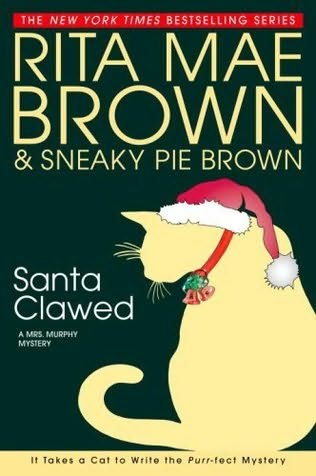
I'll admit it, I'm forcing myself to write this post tonight.  Y'all are getting a post on a series that I'm a little over halfway through, because I still (yes, still) have not powered my way through Anne Patchett's State of Wonder (don't get me wrong, I'm enjoying it, it's just not a quick read).  So, tonight, I'm going to post about Rita Mae Brown and Sneaky Pie Brown's Mrs. Murphy Mystery Series.  What kind of author is named Sneaky Pie, you ask: a cat!

The Basics
As of May 2011, there are nineteen books in this series.  That's right, 19!  And they're awesome!  The Mrs. Murphy books are cozy mysteries, meaning they're nice and light and fluffy (in this case, literally. Har har). In reading order, the books are (*deep breath*) Wish You Were HereRest in PiecesMurder at Monticello; Pay Dirt; Murder, She Meowed; Murder on the Prowl; Cat on the Scent; Pawing through the Past; Claws and Effect; Catch as Cat Can; The Tail of the Tip-off; Whisker of Evil; Cat's Eyewitness; Sour Puss; Puss in Cahoots; The Purrfect Murder; Santa Clawed; Cat of the Century; and Hiss of Death.

Got that?  As you can see, the majority of the titles include a cat-themed pun, which naturally appeals to my cheesy little heart.  The books follow the adventures of heroine, Mary Minor "Harry" Harristeen, the local postmistress of tiny, rural Crozet, Virginia.  Harry has a sense of curiosity that rivals any feline, and is routinely involving herself in mysteries that crop up in the area.  Fortunately, she is also aided by her pet tiger-cat (read Tabby) Mrs. Murphy and corgi Tucker and their numerous animal cohorts.  The two intrepid detectives are determined to protect their human, helping Harry along in solving mysteries as best they can.

The Books
Of course, the heavy feline presence throughout the books appeals to my cat-loving nature, but these books are so much more than just warm and fuzzy.  First and foremost, they are excellently written, well-plotted murder-mysteries.  The story moves along at a galloping pace as the characters (animal and human alike) rush to find the solutions to the puzzle with which they are presented.  While following the basic tenants of mystery writing - introducing the murderous character early on and dropping clues along the way - the stories are rarely predictable.  While I can usually (though not always) solve the mystery before it's revelation in the book, I always feel a sense of achievement for having done so. Not once have I been disappointed by too easy a solution.  Nor does Brown resort to hiding things from her readers in order to maintain the mystery (a device which I find cheap and annoying).  Everything you need to solve the plot is provided; you just have to follow the clues (and try not to let your dull human senses get in the way, as Mrs. Murphy would caution).

Brown also imbues her novels with a light, witty sense of humor.  This necessarily prevents the stories from becoming overly serious and also combats the potential ridiculousness of highly intelligent animals.  Speaking of whom, I am pleased to report that the animals are completely believable as characters, especially to anyone already inclined to provide pets with a voice (who me?).  The animals are every bit as intelligent as their human counterparts, however, they are still very much animals.  Mrs. Murphy sees the world through a very cat-like perspective, and Tucker is very much a dog. For example, the animals often rely on their sense of smell to help them solve the mystery at hand, a sense that is much more highly utilized by the animal world than the human.  The animals also behave as animals might: tearing through the house in a fits of anger, hunting mice, and begging for scraps from the table.

One of my favorite aspects of the series is the very vivid sense of place and people. As you're reading, you can practically feel your lungs breathing in the air that is Crozet, Virginia.  Brown has clearly rooted her town in a place and history with which she is very familiar.  Readers come away with a sense that this town could really exist, and more so, they come away with a sense of the South and of Virginia.  Brown's characters are also especially well developed (and, really, given the length of the series they'd better be); you come away with a real sense of each recurring character's strengths, weaknesses, wants, needs, etc.  Readers also witness the characters grow over the course of the series, moving through personal trials and reforming opinions.  Brown has created a literary world where readers witness the place and the people change and evolve.  This creates a binding thread that runs throughout the series, connecting readers to each book despite the varied central plots.

And really, what's not to love about a series with a book entitled Whisker of Evil co-authored by cat?

Extras

  • Don't forget to visit the author's webpage, filled with fun facts about the author and her writings.
  • Definitely read her mini autobiography while you're there.  For just a taste of her delightful sense of humor, here's an excerpt: "My entrance occurred on November 28, 1944, and the cats, hounds, and horses of the world rejoiced.  The humans didn't give a damn. What do they know?"
  • And of course the site for the Mrs. Murphy books themselves.
  • Because credit must go where it is due, here's a photo of both authors, most importantly, the illustrious Sneaky Pie:


Wednesday, November 16, 2011

Dragony Goodness

Ah dragons!  By far, one of my favorite science fiction and fantasy character types.  I recently decided to revisit a well-loved novel from my early teens:  Anne McCaffrey's Dragonflight. This book was one of my earliest introductions into the science fiction and fantasy genres.  I loved it very much at the age of 13 when my library escape was so important to me. It was nice to revisit it from a fresh and much different viewpoint, and I have to say that I find it as lovable and addictive as ever.

The Basics
McCaffrey, Anne. Dragonflight.  New York: Ballantine Books, 2005. Print.

Don't let the copyright date in the above entry fool you. This book was first published in 1968, and is, in my opinion, a classic in its genre.  Anne McCaffrey (gosh, where should I start?) is an extremely prolific and accomplished author.  McCaffrey has written nearly 100 books, coauthoring 30, and was the first woman to earn both the Nebula and Hugo awards.  She also became the first author (period) to have a science fiction book on the New York Times Best Seller list.  I could go on, but suffice it to say McCaffrey has long suffered repeated bouts of awesomeness and been well-recognized for it.  Really, if you're a fan of science fiction and fantasy and haven't read at least one of her novels you need to reevaluate your reading practices.

Of all the books in the series (and I've read most), Dragonflight is my favorite, perhaps because it represents both my initiation into the genre as well as the beginning of the planet Pern.  Set on a planet once colonized but long forgotten by Earth, the book follows the story of Lessa and F'lar, dragonriders and leaders who struggle to unite their planet and face a parasitic threat from space. (duh duhn duhnnnnn).

The Book
Dragonflight is a fantastic mixture of the science fiction and fantasy genres, blending the two in a way that will please fans of either genre.  On the one hand the book holds elements that pull it towards science fiction. The setting is a faraway planet once colonized by Earth. The characters face routine invasions by an alien species: the parasitic, spore-like Threads.  And, without revealing too much, let's not forget about the time travel.  Meanwhile, we also find fantasy elements.  Hello, dragons!  The setting is also vaguely medieval with most people living in Holds and governed by Lords.  There's also a crafthold set up frequently encountered in other fantasy novels. Dragonflight blends all these elements of genre (and many others) into one cohesive whole that's all its own.  Some of the best books defy easy categorization.

McCaffrey's characters are also rather delightful.  They feel very human and real (except the dragons, since, you know, they're dragons) with human motivations and flaws. Lessa, for example, is initially motivated by vengeance and over the course of the book has to learn to move away from that and become a leader.  The book successfully pulls her along on this journey, but she does keep a small spiteful streak that occassionally rears up and makes you want to slap her silly. Lessa, like many heroes, is also prone to spontaneous fits of vision and leaps to put such vision into action as soon as possible.  However, unlike many heroes, McCaffrey does not allow this to shape Lessa into an inhumanly successful heroine.  Instead, Lessa occasionally fails, or succeeds but at a cost to herself that teaches her to think ahead a little.  Rather than letting Lessa's vision be a superhuman strength, McCaffrey allows to be a flaw as well. (I appreciate this a lot more now than I did at 13, too).

The dragons are also rather interestingly crafted.  This was one of the first novels I read where the humans bond telepathically with their animal companions, a common enough theme now in the fantasy genre. In Dragonflight the dragons' characterization depends very much on their interactions with their humans, since dragons typically only communicate with their chosen human.  This could doom the dragons to one dimensionality, but McCaffrey skirts the issue in a number of ways.  Lessa has the ability to communicate with all dragons, which makes readers party to much more of the dragon's thoughts than they would be otherwise. Also, McCaffrey is very good at describing dragon body language (from their sarcastic tail twitches to their hungry bellies), creating a second level of communication from which readers can get to know the dragons further.

But perhaps my favorite aspect of this book is one that bleeds into the entire series: McCaffrey's affinity for worldbuilding.  I love novels that allow readers, not just to discover a great new story, but to uncover an entire new and complex world. Think about it; this is inevitably a marker of some of the best fantasy fiction out there (Tolkein, Rowling).  Pern is well crafted, featuring a system of government, a rich cultural history, and behaviors unique to the world's situation.  Nor does McCaffrey neglect the little details, such as naming traditions, cursing, common occupations, the essentials of dragoncare, etc.  What results is a well developed new world for readers to explore that goes much deeper than the surface. And while some of the elements found in McCaffrey's Pern are now fairly common in fantasy worlds created by other authors, we have to remember that Pern started in 1967 and McCaffrey likely pioneered some of this stuff!

McCaffrey's Dragonriders of Pern series is well worth dipping into, but first let me warn you that it is massive.  But, don't let that scare you off, cause you'll love it!

Extras
  • First, you can visit Anne McCaffrey's website, which features a blog and biographical information about the author.
  • You can also check out the fansite, The Pern Museum and Archives, which houses some in depth information on the series.
  • And for some visual dragony goodness, visit Michael Whelan's art site, which features many of the illustrations he originally did for the Pern series.


Wednesday, October 19, 2011

More from the Land of Faerie

The fourth installment of Karen Marie Moning's Fever Series, Dreamfever, sees our heroine finally begin to rise up from the dark, moving on to some more triumphant moments (though its still not all peaches and cream).  I have to say that blogging about a series is quite challenging; I was pretty gung ho when I started, since I love series. However, it's difficult to continue finding new topics or fresh ways to discuss old themes. I imagine its a smaller scale version of some of the challenges an author faces when writing an actual series, a challenge, I am pleased to say, that Moning continues to live up to.

The Basics
Moning, Karen Marie. Dreamfever. New York: Delacorte P., 2009. Print.

Dreamfever opens with Mac making a slow recovery from what was done to her in the previous novel, Faefever, helped along by our favorite enigma, Barrons.  The walls between Faerie and the human world have come crashing down after Halloween. The book follows Mac as she tries to organize and fight her foes, introducing Dani, a character from the previous books, as a more involved character and a sort of sidekick/ kid sister for Mac.

The Book
Speaking of Dani, she has quickly become one of my favorite characters, going from a not-so-developed side character in the earlier books to a more active figure in Dreamfever.  From the moment she takes over the first person narration of the book (briefly and during one of Mac's less than lucid moments), readers have a good idea of her spunky, brooding nature. It helps that the know-it-all, moody thirteen-year-old occupies a liminal space in life, with which many female readers will be familiar and can identify (and I'm sure my parents could recognize it as well. Heh heh).  Dani is both worldly, having the life experience to back up some of her bad attitude, and youthful, lacking the self-possessed maturity that only growing up can give you.  Aside from being an entertaining and engaging character, Dani serves a couple purposes for Moning's writing.  Firstly, it sets up Dani as an excellent lead for Moning's next set of Fever books. Secondly and most importantly to this particular series, Dani's sisterly relationship with Mac nicely mirrors Mac's relationship with her deceased sister Alina.  We are told in the earlier books that Mac looked up to her sister, a situation that is now reversed by Mac looking out for Dani and Dani's admiration of Mac.  This weaves a subtle signal throughout Dreamfever that indicates to readers Mac's new, stronger position and growth as a character.

In order to grow and continue, however, Mac must first recover from what was done to her.  This is a touchy part of the book, since after her return to awareness, Mac practically ignores what she suffered, only occasionally thinking about it with a tinge of horror.  I could see how this could be quite controversial, and some might suggest Moning sweeps the terrible violation Mac endured under the rug.  And yet, while I am by no means comfortable with the events in question, I think sometimes a great book should make you squirm. Furthermore, Moning's handling of the situation is in perfect keeping with Mac's character and her ostrich-like tendency of denial - her fatal flaw.

Barrons and Mac's relationship continues to be a delightful clashing and simultaneous attraction of wills. He helps Mac recover but immediately reverts to the distant and immutable character once she has.  Meanwhile, Mac continues to resent him, avoiding him for much of the book.  While this period apart is essential to the development of Mac's character, allowing her to grow a little on her own and test herself without Barrons to act as buffer and safety net. Only after she strikes out on her own for a while is Mac finally able to admit that there is more strength to be found in partnership with other characters.

Despite her acceptance of Barrons as an acceptable aid towards the end of the novel, he still remains shrouded in mystery. Only the tiniest of clues are revealed, never enough to solve him but always enough to keep us wanting to know more.  Nevertheless, I am convinced that Moning has finally provided us with some tangible evidence about Barrons essential nature in the last few chapters of Dreamfever.  The beast that comes to Mac's aid is surly and aggressive yet possessive and protective of Mac.  This interaction coupled with the references to Barrons's animal nature that have pervaded the series has me convince that Barrons and the beast are one and the same. Mac's horror at the end of Dreamfever only confirms this for me, since Barrons is the only character I can see her expressing such strong emotions for aside from Dani (who is clearly not involved here). But, due to a monstrously eeeevil cliffhanger, I will have to wait for Shadowfever before I find out if I'm right.  It makes me grateful that this part of the Fever series has already reached its conclusion with the fifth and final novel.

Now, since this is also a blog about food, I think I must address a recurring theme in the series: the cannibalization of Unseelie.  First and foremost, I must say blegh, blarg, and mumph. But let me explain.  Eating the foully evil Unseelie imbues the character with remarkable healing abilities and superhuman strength, stamina, and etc.  Great, right?  The Unseelie are all jerks and bad guys anyway, so who cares? Let's just say it's a rare book that I can't eat while reading, but I routinely have to stop when I encounter parts describing the imbibing of Unseelie.  Unseelie flesh is always living, even when removed from the body of its original owner, so it goes down . . . wriggling and trying to escape.  As if that weren't already enough for my overactive imagination, Mac informs me that Unseelie flesh is also primarily made up of chewy gristle, popping cartilage, and scads of bursting pustules.  Mmmmmm . . . tasty! But, Moning takes her delight in this theme a step further (clearly writing these books was getting to her) by appending a set of recipes to the back of Dreamfever.  These feature instructions for Irish soda bread; traditional Irish stew; buttermilk/strawberry scones; tea, aka finger, sandwiches; and Shepherd's pie.  All of which call for Unseelie flesh.  Needless to say I'm planning to feature the results of that Irish soda bread recipe as my next blog post.  Aren't you excited? (I can tell by your barely suppressed gags that you are. *nods head*).

Extras
  • For a synopsis of and excerpt from Dreamfever, see the book's webpage. I also recommend following the links on the sidebar to the previous books and to any deleted scenes offered.
  • Because every good fantasy realm need its own conference, I direct you towards Fevercon. (Frankly, though, the idea makes me giggle, but who am I to judge.) 


Wednesday, October 5, 2011

Those Pesky Apprentices

Well, I've been somewhat lacking in inspiration from my latest reads, skipping around from book to book in an attempt to find something that appeals.  I've finally settled on my next book, but in the meantime I need to force myself to write a post. So, this week's book post will focus on the Ranger's Apprentice series by John Flanagan.  I read most of this series a few months ago, so instead of doing a separate book per post, I'm going to go for the whole enchilada (okay, I haven't gotten to the most recent two books, but 4/5 of an enchilada just doesn't sound as good).

The Basics
I'm going to eschew my usual MLA bibliography format this time around, since I don't actually have a particular copy of any of these books on hand.  Also, I'm writing about 8 books here.  In order the books are The Ruins of Gorlan, The Burning Bridge, The Icebound Land, The Battle for Skandia, The Sorcerer in the North, The Siege of Macindaw, Erak's Ransom, and The Kings of Clonmel.  The latest three books in the series are Halt's PerilThe Emperor of Nihon-Ja, and the most recent addition, The Lost Stories, but as I haven't read those yet, we'll be ignoring them in this post.

This young adult series is written by Australian author, John Flanagan, and features the story of Will, a boy who becomes an apprentice Ranger.  The books are set in a medieval-inspired world clearly modeled on the British Isles, Europe and Scandinavia. The Rangers are a peace-keeping force that protects the kingdom from both internal and external threats and are made up of small, quick fighters trained in marksmanship and being sneaky. (So, yeah, pretty fun).

The Books
One of my favorite aspects of these books is getting to see Will's journey as a character.  It fulfills part of that going-to-Hogwarts gap that now exists in my reading life (yes, I am aware of my sheer and utter nerdiness).  Over the course of the series, we get to watch Will become an apprentice Ranger; be trained in nifty things like archery, stealth, and marksmanship; become a full-fledged Ranger with a fief of his own to patrol; and, most lately, form part of a special-ops team within the Rangers.  Watching the training is both intriguing and exciting, and it fully submerges readers in Will's world, taking us through the training right along with Will and setting our imaginations to work.

Flanagan's characters are also particularly engaging.  Will is fun because readers get to learn right along with him, making him a very relatable character. He's far from perfect, which also adds to the believability; for example, sometimes his curiosity, typically a strength, leads him into trouble, or his friendship with Horace turns to a slight bit of jealousy tinged admiration. He lacks any smarmy traits or delusions of grandeur, seeking and receiving help from his cohorts on a regular basis, which adds a touch of realism to the story.  Each character has their own strengths that contribute to the successful solution of each book's particular dilemma, and Will is adept at utilizing those strengths and asking for help when he needs it.  My other favorite character is Will's mentor, Ranger Halt, who adds the spice of mystery to things.  Halt teaches by guiding Will to learn on his own rather than being told or lectured. Over the course of the books we slowly get to know Halt and learn more about his history, a process which suits his mysterious, taciturn and prickly nature.

Flanagan is also particularly skilled at drawing his readers into the action of the books by getting us invested in the plot line and engaged in the ongoing battles.  At times, every page I read only added to my suspense until I was galloping headlong to the conclusion of the book, reading as quickly as I could without missing anything.  The author is particularly good at battle scenes, writing with such vivid detail that you can fully picture and understand the battle.  I found this especially refreshing, since battle scenes often grow boring when extended; Flanagan's highly detailed descriptions avoid this pitfall by keeping the battles interesting.  It also helps that he doesn't often repeat actions in the battle scenes, which keeps things fresh and prevents readers from turning the page and thinking, "oh boy, another battle."

If you're going to dip into this series (which I highly recommend you do), start at the beginning.  Many of the books follow right off of events from the previous installment, so skipping around could easily leave you feeling lost (dazed and confused, even).  There is one exception to this, however.  I recommend reading the seventh book, Erak's Ransom, before moving on to the fifth book, The Sorcerer in the North. The fifth book follows a time skip, abruptly moving Will up from apprentice to full Ranger without detailing the intervening year or so. Flanagan later fills in this gap with the seventh book, Erak's Ransom, and, once I discovered this, I found it much more enjoyable to read the books in chronological order rather than bibliographic order.

Overall, these books are very enjoyable and engaging reads.  They prove yet again that not all books written for a young adult audience should be restricted to that age range.  Instead, this series can appeal to a much wider (and adult) audience.

Extras
  • I highly recommend the author's website for the series, which features a spiffy interactive map of Will's world on the home page.  Did I mention there were games?
  • Teachers!  There's a classroom guide featured on the website for using the books in the classroom.
  • And, don't forget to visit the Australian publisher's website for the books! This includes a link to Flanagan's upcoming series also set in Will's world.
  • Lastly, below are the covers for the most recent three books, not covered in this blog post.