Showing posts with label romance. Show all posts

Thursday, July 26, 2012

Recent Reads

Time to play catch-up. I've been doing a lot of reading recently, but there have been a few books that just didn't make it into their own posts. So, today's post is going to be a breakdown of my recent reads (that I liked; there've been a couple that will never see light of day on this blog, sadly).

The Books
The Stork by Wendy Delsol

This book offered an interesting take on the YA supernatural romance genre.  It leans a bit more toward the romance than the supernatural, which left me wanting a little. But, it's a trilogy starter, so hopefully future books will develop the supernatural side a bit more.  It's definitely worth developing, because this book had an original take.  The heroine is part of an ancient Nordic society of "storks," women who deliver the souls of unborn children to the appropriate woman.  That part of the book was highly engaging, well done, and definitely worth reading. Links: Wendy Delsol's webpage, including more books!

The Jewel of Gresham Green by Lawana Blackwell

I was looking for something light and fluffy to read at the gym, and this book definitely filled that spot.  It's satisfyingly wholesome, focusing on several heroines and set primarily in the small town of Gresham, England in the late 19th century.  The main characters meet their trials with grace and poise.  There are several relationships to follow: a long standing marriage that continues to be strong, a recent marriage already on the rocks and in need of renewal, and a budding relationship that gives both parties a second chance at love.  The villain is malevolent and easily hate-able; you'll long for poetic justice and dance a internal jig when you get it.  A sweet, quick historical read! Links: Lawana Blackwell's website.

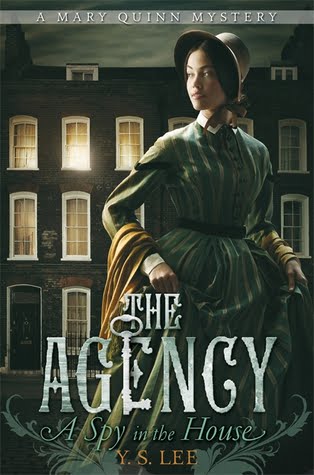
The Agency: A Spy in the House by Y.S. Lee

Continuing by recent YA binge, this book turned out to be a great Mid-century Victorian mystery set in.  The premise is nice: Mary, an orphaned thief, is rescued from the nurse and taken in by a charitable girls school.  The school's goal is to provide girls with an education that will give them better options for providing for themselves than marriage or menial service.  The Agency is an organization secretly attached to the Academy and staffed by female investigators. The book is well situated in its period and leaves lots of promising story threads to continue throughout the series.  I'm definitely eager to get my hands on the next couple books. Links: Y.S. Lee's website, especially check out the extras section!


Thursday, March 22, 2012

Romantic Reads: His Conquest

I've been on a bit of a Romance kick lately. This probably has a lot to do with the fact that romances tend to run toward the cheap on Nook books (Did I tell y'all I got a Nook for my birthday, cause I got a Nook for my birthday).  So, I've decided I'll do a new routine type of posting, similar to my Classy Classics post (and by routine I mean when I feel like reading one).  Sadly, my latest read is . . . well, only so-so.

The Basics
Cosby, Diana. His Conquest. Kensington Publishing Co, 2010. eBook.

Diana Cosby is a retired Navy Chief Meteorologist and Oceanographer, which is pretty spiffy, you know. And, other than the fact that she's a Braveheart fan, that's about all I could find on her. So far, she has authored 4 novels all part of her MacGruder series of Historical Highland Romances.

His Conquest is the third in the aforementioned series.  Running from her fiendish brother, Linet escapes his clutches accompanied by the Highland lord, Seathan MacGruder, the Earl of Grey (snicker snicker, tea, snicker), whom she released from the dungeons.  Although he's supposed to escort her to the Highlands in exchange for her freeing him, they make a small pit stop at his castle, fall in love, run into trouble, and live happily ever after. The end.

The Book
As I've already hinted I was a bit disappointed with this book.  I like my romance novels with plenty of plot, and while this book had one it was fairly flawed.  It had an interesting enough premise, set during one of the Wars for Scottish Independence during the time of William Wallace.  Being a bit of a history buff, I thought that showed plenty of promise. While it kept my attention, the plot was minimal and had some serious flow issues.  Most of the book focused on their traveling to the castle, Linet getting shouted at, and then breaking back into her home. Rather than an interesting historical plot, the entire book centers around whether or not Linet can be trusted. Since readers already know that she can, this gets pretty old rather quickly. Maybe I'm out of the norm on this, but courting is just not enough to keep me interested.

Then there's the sudden about face that happens toward the end of the book. Seathan is all brooding suspicion for the entire beginning of the novel.  He's wary that Linet might be part of a ploy to gain valuable rebel information.  There's a brief interlude when they arrive at his castle, where she meets his family and stays in his grandmother's old chamber (and we'll get to that little tidbit in a minute).  Then, he discovers that she's his enemy's sister and immediately assumes the worst. Rather than locking her up, he decides to take her with him to confront a man he thinks is a traitor and later her brother.  On the way, their party is attacked by her brother's men; during the battle she shouts a warning to Seathan about an approaching warrior and gets a gash on the head.  Seathan suddenly decides that she can be trusted, out of the blue, because she got a cut on the head. And then they have lots of s- I mean, romance (wink, wink, nudge, nudge).  I could have bought the circumstances leading up to the change, but it happens too abruptly and without any explanation, making it rather unbelievable.  I followed the logic behind the move, but to do so I had to do the story telling for myself. Not cool.

For my last gripe, I direct your attention to Cosby's introduction of magic to the story. As you all know by now, I like a touch magic in my fiction; in fact, it's hard for me to pick books that don't have a little fairy dust floating around.  But this time, it was just completely unnecessary.  Maybe if I'd read the proceeding two novels, to which this portion obviously tied in, I would appreciate it more. But I haven't and I didn't. Even if I had, it should have been worked in better.  The room Linet stays in her first night has a whiff of magic in it, and every woman who stays in it winds up married to the man who brought her to the keep.  Oh, and there are magic necklaces that come in pairs. Seathan already wears his, and Linet is highly attracted to its match. In fact she steals it and it glows and feels warm.  Sadly, my explanation about covers the extent of this subplot's involvement in the book. Had it been removed, the book would not have been any different really, so why's it there?

All that being said, it was still an okay book.  The romance parts were well done, and Cosby does the witty couple well. I even giggled a couple of times.  It's not stellar, but if you like romance more than you do plot, you may find this novel enjoyable.  She hooked me enough that I still had to know what happened. You'll never see a truly awful book on this blog, because I tend not to get through those. I'd recommend the book to big fans of the romance genre and/or Highland romances, since it satisfied those needs fairly well. She's a pretty new author by Romance genre terms, so I'm kind of interested to see where she goes and what else she produces.

Extras
 

Thursday, March 8, 2012

What Is It about Kilts, Anyway?

So the other day, I decided I needed to add a little more variety and spice here at The Book Pantry.  Mostly, this means avoiding urban fantasy for a little. Currently, I'm reading a cute cozy mystery to satisfy  this demand, but last week, I decided to pick up a (looks around furtively) Romance novel.  (Le gasp!) I find myself developing an increasing respect for the genre; there has to be something behind their popularity. It's kind of like a grown up version of a Disney princess movie: good triumphs and everyone is happily in love by the end.  I doubt I'll ever be able to enjoy the novels that are out and out smutty erotica, but throw in a decent amount of plot and I can get with it.

The Basics
Banks, Maya. In Bed with a Highlander. New York: Ballantine Books, 2011. Print.

Maya Banks is a best-selling author of lots of romances, many of will hopefully be set in Scotland. She lives in Texas with her husband, three children, several cats (that's totally the important part of this bio), and a dog.

In Bed with a Highlander tells the story of Mairin Stuart and Ewan McCabe. Mairin is the illegitimate daughter of the former king of Scotland and is hounded by an unfortunately substantial and strategically valuable dowry.  This might be fine if she had any protection, but instead she's on her own.  To her good fortune, she encounters Ewan McCabe, who is out for more than her dowry.  Ewan is a warrior determined to provide security for his clan and seek revenge on his enemies, while Mairin is a spirited young woman raised by nuns. Predictably, antics ensue.

The Book
First, let me say that I thoroughly enjoyed this book and would highly recommend it. Nevertheless, I have a few gripes.  I'll start with the title and cover.  I see a lot of romance titles come through the library, and I've noticed a trend.  A good number of romances go for titles that are quite literal. I find most romance novel titles giggle-worthy, but I'll take one called Big Bad Beast over a more literal title any day.  In Bed with a Highlander? Come on! Leave something to the imagination here! As for the cover of this particular novel: I like it when the cover matches a character's description. Also, that lingerie doesn't really seem period to me . . . (this bugged me way more than is reasonable).

Okay, so those are pretty minor gripes that made me giggle more than actually irritated me.  (And I'm sure you can tell by now that I secretly like anything that makes me laugh). But I have a major one that actually intertwines with one of my favorite parts of the novel: Mairin's characterization.  Having been raised by nuns in a, well, cloistered environment, Mairin is understandably naive. At times, this leads to some absolutely hilarious situations (like her puzzlement over why tongues are involved in kissing). However, there are times in the novel when this naiveté crosses over into the realm of stereotypical stupidity, and this really irritates me. For the most part, Mairin strikes me as a strong-willed, intelligent woman, so these moments of stupidity are not just annoying, but out of character.  When the other characters seem a step away from saying "silly Mairin" and patting her on the head, I want to maim someone. Fortunately these moments are few and far between. Overall Mairin is a great character, who stands up both for herself and for what she believes to be right.  For me, this makes her easier to identify with, which is essential for this sort of novel. No shrinking violets here!

When reading a romance novel, it's very important that the romance be interspersed with plenty of plot. I just cannot stay interested in a book that is all fluff and smooching.  So, when I decided to do a romance novel for the blog, I went in search of one that looked like it had an interesting and involved story line.  Banks more than lives up to that expectation.  Much of the novel focuses on the everyday parts of Mairin's life as she adjusts to being married and the mistress of a clan.  This makes for an engaging and delightfully light bit of reading. Alongside this is a heavier and more serious plot of political intrigue.  This plot line provides a feasible explanation for Mairin's situation in life and a reason for where she winds up. It also adds an element of suspense to the novel and an overarching problem to be solved as Mairin seeks safety and stability.  I also enjoyed the amount of potential the plot of this novel leaves for the sequels (which I will be reading; a sure sign of a good plot is one that leaves you wanting to know more).

Banks clearly has a great sense of humor, which she shares with readers throughout the novel.  I often pick of romance novels only to hysterically laugh when that was clearly not the intended reaction. I loved that this novel only illicits that response deliberately.  Mairin is slightly clumsy (and can't we all identify) when it comes to learning how to manage her household.  The humor involved in these situations serves to make readers like Mairin even more and ultimately root for her and be pleased when she finally succeeds.  Mairin and Ewan both attempt to "manage" one another over the course of the novel, often to spectacularly failed results. Banks's use of humor makes this trope fun and enjoyable when it might otherwise have been tedious and hackneyed.

Lastly, I loved the setting of the novel.  Admittedly, my own heritage might have biased me a bit, but come on. Beautiful scenery, ruggedly handsome men, accents, tartans, and a delightfully historical setting, what's not to love! I also enjoyed the lack of kilts and overdone colloquial speech patterns. Instead, Banks imbues the novel with just the right amount of Scottish Highland flavor. She takes readers to the Highlands, without also taking them to the set of a really bad made-for-tv movie. So, we get all the enjoyment with out any gag-worthy bits.

Extras
  • Maya Banks has a lovely personal website, filled with additional information and easily navigable (I'm a sucker for a well-made website).
  • She has a specific section dedicated to the McCabe trilogy, of which In Bed with a Highlander is the first, that includes a delightfully dramatic series trailer.
  • Lastly, Banks keeps a well-maintained and frequently updated blog, named Southern Sin.

   Pin It

Thursday, January 12, 2012

Classy Classics: Austen Edition

So I know it was only fairly recently that I did a Classics post, but it was time for my semi-annual reread of Pride and Prejudice.  This book is easily one of the best loved pieces of English Literature, and if you haven't read it yet, that right there should be reason enough (of course, it's my favorite, too, which I'm sure will influence your decision properly).  I've long adored this book, and I think I like it better with each reading.

The Book
Austen, Jane. Pride and Prejudice. Oxford: Oxford UP, 2004. Print.

Pride and Prejudice focuses on the Bennet family, especially Miss Elizabeth Bennet.  The story follows Elizabeth along with her sisters as she navigates the society of the early 1800s in the British upper class.  The novel follows the main characters as they make the transition from girlhood to marriage; an all-important stage in the life of young woman at the time.  Along the way, Elizabeth must navigate the follies and foibles of her family, her acquaintances, and society as a whole.

Why You Should Read this Book
The characters, for one thing, are such that readers quickly become invested in their lives.  Some, like Elizabeth and Jane, you'll love and be eager to see how they grow and become well-married.  Others, like Lydia or Mr. Wickham, you'll be dying to see get their comeuppance. Austen crafts her characters with so much personality, that it's easy to get attached (even to the loathsome ones).  Elizabeth, for example is witty, clever, and good-natured, but Austen keeps her slightly flawed. All her intelligence is not enough to keep an unworthy from taking her in with the appearance of goodness. Nor does she entirely know herself: her encounters with Mr. Darcy over the course of the novel spur her to grow and become better and wiser and vice versa until they are a suitable match for one another.

I also love Austen's more ridiculous characters: Mrs. Bennet, Mr. Collins, and Lady Catherine de Bourgh.  There's really not much to say about Mrs. Bennet, since her character is so injudiciously obvious.  But, Mr. Collins and all his obsequiousness is delightfully squirm-worthy and laughable.  Naturally, he and his overly proud, "condescending" patroness, Lady Catherine go hand in hand.  As someone who delights in the ridiculous almost as much as Elizabeth, the novel provides ample opportunities for a laugh.

Austen's prose is also fantastic, as one would expect of a novel so beloved. She writes incredibly well, and it offers modern readers a glimpse of speech and writing patterns from the period.  At the same time, it is remarkably accessible writing that is easily understandable and engaging of interest once you get used to it. This makes it an ideal novel for a wide audience, even those who don't typically find classics readable (take that Charlotte Bronte). Her phrasing is by turns delightful, sweet, and subtly funny. It makes a great introduction to classics for any reader, though perhaps especially for young girls.

The story itself is a light romance.  You have your witty couple as well as your sweet couple, but with plenty of twists, turns and near misses to keep things interesting.  It's no wonder so many modern romances reference Austen's work. One thing I particularly liked about the edition I was reading from was that it was annotated. Granted some of the notes are perfectly useless (I mean, who can't figure out that amiable refers to someone's "friendly disposition" 313), but others clue readers in to little nuances of the period completely unknown to modern readers and that would otherwise be missed. Even for someone who's studied a good bit in both the long 18th century and Victorian literary periods (cough, cough), they're darned useful.

Seriously, why aren't you picking up this book already? (Go! Go now! *cracks whip*)

Extras
  • Let's talk movies!  The recent 2005 version of Pride and Prejudice, starring Kiera Knightly is quite good.  It's visually stunning, has a great cast, and features excellent scenes and costuming. It's true enough to the story, but the editing is a little rough and makes it hard to follow at times.
  • The 1995 BBC mini-series, starring Colin Firth and Jennifer Ehle is also amazing and highly recommended. It's incredibly true to the story, features a solid cast (Colin Firth!), and excellent costuming.  It's by far my favorite. (yes, I brought it home from the library again. What?).
  • The 1980 mini-series, also by the BBC, is atrocious.  Its casting is questionable and its script jumps all over the book. It would make an excellent piece to watch with friends and sarcastically comment on throughout, however.
  • There's also tons of other versions, including a 1940 one, which I plan to find soon.


Wednesday, November 9, 2011

Villainy and a Cat

It's about time for me to feature another Young Adult novel on the blog, so today's post will focus on Catherine Gilbert Murdock's recent release, Wisdom's Kiss.  As the covers declares, this book is a "Thrilling and Romantic Adventure Incorporating Magic, Villainy, and a Cat." The book fulfills that promise and more and is eminently suitable for its target teen audience, perhaps most especially girls.  Although, we all know that the black cat on the cover is what really attracted me to the book.

The Basics
Murdock, Catherine Gilbert. Wisdom's Kiss. Boston: Houghton Mifflin, 2011. Print.

Murdock was born in South Carolina and grew up on a Christmas tree farm (Christmas is my favorite holiday, so I think that's pretty awesome).  She is the author of several young adult books, including the acclaimed Dairy Queen series.  She is also the sister of Elizabeth Gilbert of Eat, Pray, Love fame.  Wisdom's Kiss is a sequel of sorts to Murdock's novel, Princess Ben. However, it's definitely a stand-alone story, set in Ben's world, but not really picking up any of the same story line. (I have not, yet, read Princess Ben, and I was just fine).  The story follows several characters, including the prescient tavern maid, Trudy; the miller's son turned "soldier," Tips; and the adventure-seeking, not-wise-at-all Princess Wisdom.  Wisdom hastily agrees to marry the Duke of Farina on the promise of adventure, only to realize too late that she is about to enter into a family of immoral schemers.  The novel is full of adventure and suspense with just a dash of romance and magic to help things along.

The Book
There are so many things to love about Wisdom's Kiss that it's hard to know where to start. (Seriously, I've been dreading having to write this post). But, perhaps the most striking feature of the novel is the variety of forms that Murdock uses to tell her story: epistolary (letters), diary entries, a play, encyclopedia entries, and first and third person narratives.  Knowing this before I went in, I was a little wary and worried that the book would seem disjointed, but I discovered that just the opposite was true.  Each form Murdock uses tells the story of Wisdom's Kiss (here I refer to the event rather than the novel) from the perspective of a different character, giving readers a fuller picture of the story than they would find by following only a few perspectives. (It also thrills my inner literary nerd to see all the different forms).

I also liked how Murdock managed to connect all the threads of her various characters into one cohesive story line. With characters from such disparate worlds as Trudy the village tavern maid and Princess Wisdom the spoiled thrill seeker, it was important for Murdock to convincingly pull all the characters together, which she does.  She does this in large part through the various mysteries swirling around the novel.  The mystery of the nature of Tips's true profession ultimately pulls Trudy (though she has no idea there's a mystery until it's solved) along in the story line, leading her to link up with Wisdom and the Queen Mother.  Then we have the mystery surrounding Wisdom's fiance's mother and her machinations, which drive the overarching plot of the book.  A clever reader can follow along and even anticipate the goings-on that so puzzle the characters, but Murdock still manages to slip in some twists that you won't see coming. (At least one even had me exclaiming aloud). 

In all this plotting and storytelling, we also find some really great characters.  Murdock develops these characters with ease through her use of literary forms.  Each one has a particular form in which his or her story is told. Trudy gets a 3rd person narrative memoir; Wisdom, a diary; the Queen Mother, letters to her granddaughter Queen Temperance ; Tips, letters to Trudy; Felis, pompous 1st person narrative accounts of the past; and more.  And if any character need fleshing out beyond first hand accounts, we get entries in the Encyclopedia of Lax.  The book largely focuses on movement through the plot as each character is inexorably drawn to the conclusion, but in telling the story through each character's perspective and voice, Murdock simultaneously creates a real sense of character that seems so much more effortless than other novel's lengthy character descriptions.  I get the feeling that each reader will form their own attachments and have their own favorite characters, since each of Murdock's creations are equally engaging. (Personally, I liked the Queen Mother).

Lastly, you'll love the book's light and witty sense of humor that permeates almost every page. For one thing, Murdock selects some truly hilarious names for things, such as the Empire of Lax, the Siege of Cheese, or the Magnanimous Goat Incident (which, really, I'd like to know more about).  Princess Wisdom is also a great source of humor.  She's constantly and irreverently poking fun at things, creating an interesting combination of insensitive and hilarious.  For example, she ridicules her own country's naming traditions after learning that Trudy's mother's name was Mindwell: "Which is extremely ugly & extremely virtuous & only someone from Montagne would ever inflict something that awful on a poor defenseless little baby girl!" (239-40). My favorite moment, though, comes after Wisdom's entire retinue grows violently ill after eating some bad oysters and Wisdom deems the subsequent trip to Trudy's village the "Puking Path" (47).

I loved every minute of Wisdom's Kiss and think it would make an excellent stocking stuffer for the teenage girl in your life (or am I the only weirdo who thinks books are great stocking stuffers?). I know I would have adored this book as a teen. I mean, come on, it features a black cat named Escoffier for crying out loud!

Extras

Wednesday, October 19, 2011

More from the Land of Faerie

The fourth installment of Karen Marie Moning's Fever Series, Dreamfever, sees our heroine finally begin to rise up from the dark, moving on to some more triumphant moments (though its still not all peaches and cream).  I have to say that blogging about a series is quite challenging; I was pretty gung ho when I started, since I love series. However, it's difficult to continue finding new topics or fresh ways to discuss old themes. I imagine its a smaller scale version of some of the challenges an author faces when writing an actual series, a challenge, I am pleased to say, that Moning continues to live up to.

The Basics
Moning, Karen Marie. Dreamfever. New York: Delacorte P., 2009. Print.

Dreamfever opens with Mac making a slow recovery from what was done to her in the previous novel, Faefever, helped along by our favorite enigma, Barrons.  The walls between Faerie and the human world have come crashing down after Halloween. The book follows Mac as she tries to organize and fight her foes, introducing Dani, a character from the previous books, as a more involved character and a sort of sidekick/ kid sister for Mac.

The Book
Speaking of Dani, she has quickly become one of my favorite characters, going from a not-so-developed side character in the earlier books to a more active figure in Dreamfever.  From the moment she takes over the first person narration of the book (briefly and during one of Mac's less than lucid moments), readers have a good idea of her spunky, brooding nature. It helps that the know-it-all, moody thirteen-year-old occupies a liminal space in life, with which many female readers will be familiar and can identify (and I'm sure my parents could recognize it as well. Heh heh).  Dani is both worldly, having the life experience to back up some of her bad attitude, and youthful, lacking the self-possessed maturity that only growing up can give you.  Aside from being an entertaining and engaging character, Dani serves a couple purposes for Moning's writing.  Firstly, it sets up Dani as an excellent lead for Moning's next set of Fever books. Secondly and most importantly to this particular series, Dani's sisterly relationship with Mac nicely mirrors Mac's relationship with her deceased sister Alina.  We are told in the earlier books that Mac looked up to her sister, a situation that is now reversed by Mac looking out for Dani and Dani's admiration of Mac.  This weaves a subtle signal throughout Dreamfever that indicates to readers Mac's new, stronger position and growth as a character.

In order to grow and continue, however, Mac must first recover from what was done to her.  This is a touchy part of the book, since after her return to awareness, Mac practically ignores what she suffered, only occasionally thinking about it with a tinge of horror.  I could see how this could be quite controversial, and some might suggest Moning sweeps the terrible violation Mac endured under the rug.  And yet, while I am by no means comfortable with the events in question, I think sometimes a great book should make you squirm. Furthermore, Moning's handling of the situation is in perfect keeping with Mac's character and her ostrich-like tendency of denial - her fatal flaw.

Barrons and Mac's relationship continues to be a delightful clashing and simultaneous attraction of wills. He helps Mac recover but immediately reverts to the distant and immutable character once she has.  Meanwhile, Mac continues to resent him, avoiding him for much of the book.  While this period apart is essential to the development of Mac's character, allowing her to grow a little on her own and test herself without Barrons to act as buffer and safety net. Only after she strikes out on her own for a while is Mac finally able to admit that there is more strength to be found in partnership with other characters.

Despite her acceptance of Barrons as an acceptable aid towards the end of the novel, he still remains shrouded in mystery. Only the tiniest of clues are revealed, never enough to solve him but always enough to keep us wanting to know more.  Nevertheless, I am convinced that Moning has finally provided us with some tangible evidence about Barrons essential nature in the last few chapters of Dreamfever.  The beast that comes to Mac's aid is surly and aggressive yet possessive and protective of Mac.  This interaction coupled with the references to Barrons's animal nature that have pervaded the series has me convince that Barrons and the beast are one and the same. Mac's horror at the end of Dreamfever only confirms this for me, since Barrons is the only character I can see her expressing such strong emotions for aside from Dani (who is clearly not involved here). But, due to a monstrously eeeevil cliffhanger, I will have to wait for Shadowfever before I find out if I'm right.  It makes me grateful that this part of the Fever series has already reached its conclusion with the fifth and final novel.

Now, since this is also a blog about food, I think I must address a recurring theme in the series: the cannibalization of Unseelie.  First and foremost, I must say blegh, blarg, and mumph. But let me explain.  Eating the foully evil Unseelie imbues the character with remarkable healing abilities and superhuman strength, stamina, and etc.  Great, right?  The Unseelie are all jerks and bad guys anyway, so who cares? Let's just say it's a rare book that I can't eat while reading, but I routinely have to stop when I encounter parts describing the imbibing of Unseelie.  Unseelie flesh is always living, even when removed from the body of its original owner, so it goes down . . . wriggling and trying to escape.  As if that weren't already enough for my overactive imagination, Mac informs me that Unseelie flesh is also primarily made up of chewy gristle, popping cartilage, and scads of bursting pustules.  Mmmmmm . . . tasty! But, Moning takes her delight in this theme a step further (clearly writing these books was getting to her) by appending a set of recipes to the back of Dreamfever.  These feature instructions for Irish soda bread; traditional Irish stew; buttermilk/strawberry scones; tea, aka finger, sandwiches; and Shepherd's pie.  All of which call for Unseelie flesh.  Needless to say I'm planning to feature the results of that Irish soda bread recipe as my next blog post.  Aren't you excited? (I can tell by your barely suppressed gags that you are. *nods head*).

Extras
  • For a synopsis of and excerpt from Dreamfever, see the book's webpage. I also recommend following the links on the sidebar to the previous books and to any deleted scenes offered.
  • Because every good fantasy realm need its own conference, I direct you towards Fevercon. (Frankly, though, the idea makes me giggle, but who am I to judge.) 


Thursday, September 22, 2011

There's a Bad Moon on the Rise

To continue with the Fever series by Karen Marie Moning, this post will focus on the second and third books: Bloodfever and Faefever.  I'm still very much enjoying the series, as immersed as ever. The great thing about a series when blogging is that it provides the opportunity to expand beyond the basics of what makes a book good.  I can provide more depth and expound on themes and details.  This nicely mirrors what I love about series: the depth of world and character afforded by multiple books.

The Basics
Moning, Karen Marie. Bloodfever. New York: Delacorte P., 2007. Print.

Moning, Karen Marie. Faefever. New York: Delacorte P., 2008. Print.

Since my last post, I have learned that Moning (which rhymes with awning, not moaning, sorry Mom) is contracted to write at least three more books in the Fever series and is also currently working on a graphic novel featuring Mac (So fun stuff, yesh?). In these two novels, Mac descends even further down the rabbit hole, growing stronger as she goes.  However, despite Mac's character growth, the books are definitely a descent into to some quite dark depths. As of the end of Faefever, Mac is in one of the darker, more disturbing places I've had a book take me.  So much so that I am still not sure what I thought about the process that took me there.

The Books
In these next two books, Moning maintains many of the same themes that made Darkfever so addictive a read.  The humor that runs throughout the books continues to startle laughs out of me; a rarity since most books only succeed at producing a smirk accompanied by an internal giggle.  Whether Mac is getting caught dancing along to CCR's "Bad Moon Rising" wearing a light up helmet (which I swear fits perfectly in the plot) or is sneakily getting the better of Barrons only to have the rug swept out from under her feet in spectacular fashion (FF 131, 220), both Bloodfever and Faefever are laugh-out-loud funny.  And, given the ever-strengthening darkness that fills most of the pages, Moning's injection of humor provides much needed doses of comic relief, without which the books may well become too hopeless to be enjoyable.  Since maintaining hope in the face of fear is one of Moning's chief themes, her use of humor enables her to go beyond keeping hope in her characters and helps instill it in her audience.

While we're on the topic of themes, one of the most engaging in the Fever series so far has been the mystery behind Barrons's character. This particular mystery draws the reader's curiosity and keeps the audience constantly questing for additional information (especially if you're possessed by an insatiable need to know everything. Down Hermione!). Moning gives Mac just enough to make her think she might be about to discover a part of Barrons's true nature before she finds herself back at square one.  For example, Mac, being quite sure of herself and having provided a fairly convincing argument to her audience, believes she has proof that Barrons is actually an evil Unseelie.  While a careful reader will have found all sorts of holes in this theory (again showing Mac is not perfect), I still read with bated breath as Mac handed Barrons the spear (untouchable by Unseelie) only to have him hold it without flinching (FF 215-16).  Moning tantalizes us with just enough new information to keep us interested and guessing, without enough to really give us an answer.  Thus, we may discover Barrons is centuries old without learning even the significance of that information, and so we remain absorbed.

One of the more disturbing themes that runs throughout the series is that of consent, or rather the lack thereof.  Mac is frequently confronted by situations that hinder or remove her will.  At times this appears in the form of one of her supposed allies, a fae prince, attempting to control her by inciting all-encompassing lust (pick a spot; this happens repeatedly). At other times, Mac is being tested by her archenemy who uses Druid "Voice" to override her will with his own and force her to follow.  Whatever the cause, each time this occurs Mac overcomes either through rescue or regaining her will on her own.  This vulnerability makes it easy for a female reader to identify, since issues of will seems to be a timeless problem faced by women.  Nevertheless, I was a bit weirded out by this repeated theme, especially given its close association to mostly the vaguely sexual moments in the novels. But perhaps that's a good thing, and we need to be made to squirm a bit; regardless, these moments are less about entertainment and more about growth.  My unease turned out to be the result of well-crafted foreshadowing on Moning's part, since by the end of Faefever, Mac has fallen into a terrifying space where not only does she lack will, the idea of will holds no meaning for her at all. Disturbing, yes? But entirely necessary.  Moning has made it clear that these books are not about darkness but light; I suspect we'll appreciate that light much more after the dark place Moning takes us to.

Moning weaves plot threads that hold throughout her series rather than dropping off with each book, creating a really cohesive feel between the novels.  This is helped along by her pacing, which stays consistent within each book.  Moning moves her readers along in a book at a steady pace with occasional dips and spikes before dropping us off a sheer cliff face at the climax.  Rather than a steady build up before letting us roll down hill, Moning opts for a more dramatic plummet, making for an exciting finale.  I particularly like that this drop is typically followed by a chapter of recovery that wraps up nicely while leading into the next installment.

After three books (which despite the pacing of the blog, I finished in about 4 days), I'm still every bit as eager to continue in the series.  Thank goodness she's contracted for more!

Extras

  • In case you're wondering about that aforementioned book contract, try visiting this forum on Moning's website.  The forum itself is super spiffy, since Moning herself seems to be pretty involved.
  • Zomg! Moning has a BLOG! Right here on blogspot.
  • Last but not least, I direct you to the Fever series fan site Sidhe-Seers Inc. (Though the character who runs said organization in the books is loathsome so far.)


Thursday, September 15, 2011

You Give Me . . . Fever?

Today's book is Darkfever by Karen Marie Moning.  I have been tempted once again by the siren call of a series.  There's just something about being able to immerse myself in a fictional world, not once but repeatedly, that holds and almost endless appeal for me.  I'm already looking forward to the next book (I already have all 5 stacked on my coffee table fresh from the library) so much that I can hardly force myself to write this before moving on.  Ironically, this is a blog post that almost wasn't, since I was initially put off of the Fever series by repeated descriptions and classifications of the books as Romances. (Blegh. Yucky!) But after reading a more detailed summary, I decided that these books might be for me after all.


The Basics
Moning, Karen Marie. Darkfever. Detroit: Thorndike P., 2006. Print.

Karen Marie Moning a #1 New York Times Best-Selling Author is the author of two successful series and the recipient of the RITA award. The Highlander series, which I am given to understand feature time-travel and ruggedly handsome Scotsman, are a set of paranormal romances.  Her second series, which we'll be concerned with here in my blog, begins with Darkfever, an Urban Fantasy set in Ireland.  In this book, our intrepid heroine travels to Ireland to avenge the death of her murdered sister, discovering in the process a world filled with dangerous fae and her own recently uncovered power to see such creatures.

The Book

So, funny story, my mother was over at my apartment last night with my Aunt, who was looking through my book stack.  My mom saw Darkfever sitting on the table; the author's last name is the most prominent thing on the cover.  She saw this and exclaimed, "that's not how you spell it!" To which I replied, "Mom! That's her name!  She can spell it however she likes." She had mistaken it for the book's title and thought it should have been "moaning," which given the cover art on this edition* would, indeed, seem apt (see extras).

Which brings me to my single gripe (that is no fault of the book): why was this billed as a romance in some places?  Is it because Moning is well-known for romance?  Do romances simply sell?  Moning's website, certainly doesn't caste the book this way; there it is billed as Urban Fantasy, a category that makes much more since.  But perhaps I am in the minority when I am repulsed by heaving bosoms being ripped from their bodices by the burly Brawny man.  Yes, I realize that not all romance novels fit that bill and some are quite good fiction, but that stereotype was roughly how I first saw this book described. I suppose I am indignant because I came so close to missing out on a truly wonderful and absorbing book. According to the Romance Writers of America website "all romances contain a central love story," which was conspicuously absent from Darkfever.  Although, I suppose there is potential for one to develop over the course of the series.  I must admit to some confusion about the romance genre.  Tons of books feature a romance but are categorized as mysteries, fantasy, or just plain fiction.  I guess I just don't see the point, and maybe more research is in order.  Ultimately, I like my books with plenty of plot and character with just a smidge of romance, like a condiment, to add a little extra spice.

But enough about genre, because this book is far too good to get caught up on that.  For the first time in quite a while, I found myself so completely absorbed in a book that everything around became irrelevant.  Time and being directly addressed were completely ignored. Rather than being able to read while at the same time surfing the net and watching my boyfriend play video games, I was unable to peel my eyes away from the page.

Narrated in first person by the heroine, much of the book relies on character development.  And Mackayla Lane is delightfully flawed.  A tiny bit selfish and initially lacking in motivation, Mac is spunky and full of bluster, and we follow her along as she slowly learns her way around the world she's stumbled into.  Her constant urge to stick her head in the sand and enter a state of denial can be especially frustrating, but it's also what makes her character. As the plot forces her toward a state of enlightenment, we get to watch her character grow, and this makes her entirely believable.  Rather than jumping in with a strong kick-ass heroine who jumps in and out of an unbelievable number of scrapes only to come out scathed but even badassier than before (*cough* AnitaBlake*cough*), we instead have a character whose innocence and capacity for denial starts her from a weak point and we get to see her grow gradually stronger, learning as she goes.

It also helps that Mackayla is highly relatable.  I had my doubts from the moment I first read her name and thought, "Mackayla? Seriously?" However, after a little poking around I discovered that this is an Americanized spelling of the traditionally Irish name, Michaela.  I decided that maybe it might be okay, and I could forget about my associations with that ill-mannered country girl who smacked her mouth loudly as she chewed her gum in 10th grade political science.  Also, the nickname of Mac is way cool. But I digress.  Mac is relatable as a thoroughly modern heroine, who listens to her ipod and can actually use a computer (I'm looking at you Sookie Stackhouse). I also like that she's distinctly southern; being from the South myself, southern heroines hold a special place in my heart.  She comments on such topics as manners and hospitality that leave me giggling: "When I opened my door, I discovered someone had been busy while I'd slept. A bakery bag, a bottled latte, and my luggage were outside my door.  Down South store-bought food outside your bedroom door isn't a treat - it's an insult. . . . Stay out of my kitchen, the bag said, and don't go looking around. Down South it meant, Leave before lunch, preferably now. (161).  The expression of her grief over the loss of her sister also helps make Mackayla a relatable human rather than one-dimensional. Moning depicts this so well that it feels as if it's the expression of real emotion rather than the made up mourning of a non-existent character.

As much as Darkfever relies on Mac's character, it is also driven by plot, particularly mystery.  Jericho Barrons's (stop snorting at the name, please; nah, go ahead) could be accused of being a one-dimensional character, but I would argue otherwise.  His character is instead left intentionally shrouded in mystery, so that the uncovering of tidbits about his character becomes an essential plot element as well. It helps that his physical presence in the book is every bit as vivid for the reader as it is for the characters he interacts with; he exudes energy, brio, and menace.  It is only at the very end of the book that the reader can stop flip-flopping about whether his character is good or not . . . maybe.

And the mystery of Barrons's character is only one of many plot threads that Moning weaves into her story.  We follow Mackayla in her efforts to discover her sister's murderer.  We watch as Mac learns new truths about herself.  We delve into a whole new world right along with her. We doggedly keep following Mac as she traces the whereabouts of ancient Fae relics and ultimately as she discovers herself participating in the beginnings of an underground war.  Fun, right?

The whole book is about discovery, and it drags the reader in, captivating them as much as any Fae. Urban fantasy, with the occasional mirror-fogging scene, Darkfever was a great read.  And now, I'm going to abandon further blogging in favor of the next book!

*Please note my page numbers may seem odd since I'm working from a large print edition as it was the only one in the library when my greedy little paws proceeded to check out the entire series. Heh heh.

Extras

  • For more information about the author and/or her series, please consider her website.
  • For information on Romance and its sub-genres see the RWA website.
  • Looking for name information? Try this webpage.
  • This is the picture from the cover of the large print edition my mother saw.  I couldn't get the freaking thing to format properly in the post above, hence it's position down here. *shakes fist at blogger interface*