Showing posts with label writing. Show all posts

Thursday, December 8, 2011

The Cat's Meow

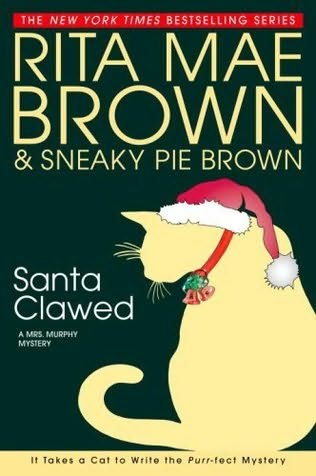
I'll admit it, I'm forcing myself to write this post tonight.  Y'all are getting a post on a series that I'm a little over halfway through, because I still (yes, still) have not powered my way through Anne Patchett's State of Wonder (don't get me wrong, I'm enjoying it, it's just not a quick read).  So, tonight, I'm going to post about Rita Mae Brown and Sneaky Pie Brown's Mrs. Murphy Mystery Series.  What kind of author is named Sneaky Pie, you ask: a cat!

The Basics
As of May 2011, there are nineteen books in this series.  That's right, 19!  And they're awesome!  The Mrs. Murphy books are cozy mysteries, meaning they're nice and light and fluffy (in this case, literally. Har har). In reading order, the books are (*deep breath*) Wish You Were HereRest in PiecesMurder at Monticello; Pay Dirt; Murder, She Meowed; Murder on the Prowl; Cat on the Scent; Pawing through the Past; Claws and Effect; Catch as Cat Can; The Tail of the Tip-off; Whisker of Evil; Cat's Eyewitness; Sour Puss; Puss in Cahoots; The Purrfect Murder; Santa Clawed; Cat of the Century; and Hiss of Death.

Got that?  As you can see, the majority of the titles include a cat-themed pun, which naturally appeals to my cheesy little heart.  The books follow the adventures of heroine, Mary Minor "Harry" Harristeen, the local postmistress of tiny, rural Crozet, Virginia.  Harry has a sense of curiosity that rivals any feline, and is routinely involving herself in mysteries that crop up in the area.  Fortunately, she is also aided by her pet tiger-cat (read Tabby) Mrs. Murphy and corgi Tucker and their numerous animal cohorts.  The two intrepid detectives are determined to protect their human, helping Harry along in solving mysteries as best they can.

The Books
Of course, the heavy feline presence throughout the books appeals to my cat-loving nature, but these books are so much more than just warm and fuzzy.  First and foremost, they are excellently written, well-plotted murder-mysteries.  The story moves along at a galloping pace as the characters (animal and human alike) rush to find the solutions to the puzzle with which they are presented.  While following the basic tenants of mystery writing - introducing the murderous character early on and dropping clues along the way - the stories are rarely predictable.  While I can usually (though not always) solve the mystery before it's revelation in the book, I always feel a sense of achievement for having done so. Not once have I been disappointed by too easy a solution.  Nor does Brown resort to hiding things from her readers in order to maintain the mystery (a device which I find cheap and annoying).  Everything you need to solve the plot is provided; you just have to follow the clues (and try not to let your dull human senses get in the way, as Mrs. Murphy would caution).

Brown also imbues her novels with a light, witty sense of humor.  This necessarily prevents the stories from becoming overly serious and also combats the potential ridiculousness of highly intelligent animals.  Speaking of whom, I am pleased to report that the animals are completely believable as characters, especially to anyone already inclined to provide pets with a voice (who me?).  The animals are every bit as intelligent as their human counterparts, however, they are still very much animals.  Mrs. Murphy sees the world through a very cat-like perspective, and Tucker is very much a dog. For example, the animals often rely on their sense of smell to help them solve the mystery at hand, a sense that is much more highly utilized by the animal world than the human.  The animals also behave as animals might: tearing through the house in a fits of anger, hunting mice, and begging for scraps from the table.

One of my favorite aspects of the series is the very vivid sense of place and people. As you're reading, you can practically feel your lungs breathing in the air that is Crozet, Virginia.  Brown has clearly rooted her town in a place and history with which she is very familiar.  Readers come away with a sense that this town could really exist, and more so, they come away with a sense of the South and of Virginia.  Brown's characters are also especially well developed (and, really, given the length of the series they'd better be); you come away with a real sense of each recurring character's strengths, weaknesses, wants, needs, etc.  Readers also witness the characters grow over the course of the series, moving through personal trials and reforming opinions.  Brown has created a literary world where readers witness the place and the people change and evolve.  This creates a binding thread that runs throughout the series, connecting readers to each book despite the varied central plots.

And really, what's not to love about a series with a book entitled Whisker of Evil co-authored by cat?

Extras

  • Don't forget to visit the author's webpage, filled with fun facts about the author and her writings.
  • Definitely read her mini autobiography while you're there.  For just a taste of her delightful sense of humor, here's an excerpt: "My entrance occurred on November 28, 1944, and the cats, hounds, and horses of the world rejoiced.  The humans didn't give a damn. What do they know?"
  • And of course the site for the Mrs. Murphy books themselves.
  • Because credit must go where it is due, here's a photo of both authors, most importantly, the illustrious Sneaky Pie:


Wednesday, November 30, 2011

A Questionable Talisman

Soooooo, about a couple weeks (and by "couple weeks" I mean a month) ago I read the memoir, Three Wishes by Carey Goldberg, Beth Jones, and Pamela Ferdinand, and I've been avoiding writing about it ever since.  Don't get me wrong; it's a pretty good book. It's just one of those that are really hard to put into words.  But the authors managed in the first place, so I can at least  put together a semi-coherent review. (yes? Yesh.)

The Basics
Goldberg, Carey, Beth Jones, and Pamela Ferdinand. Three Wishes. New York: Little, Brown, and Co., 2010. Print.

All our authors have achieved significant recognition throughout their careers as writers and journalists (they're writers! Who'd a thunk?), writing for the likes of The New York Times, The Boston Globe, and The Washington Post. And no wonder, since if this book is any evidence, they're all superb writers. The memoir traces each author's journey toward equal success in their romantic and family lives.  As the book progresses, each woman relates her realization that she was tired of waiting for the right man to come along and enable her to have children.  Carey gets things started (so to speak. Sorry, I'm sorry.) by purchasing several vials of sperm from a bank. But before she can really put them to use, she finds love.  The vials are then passed to Beth, and the same process occurs. So they move to Pam, and again love strikes. (Like magic!)

The Book
This was a book that surprised me. Obviously I picked it up because I found the premise intriguing.  I'll admit I also had talismanic images of sperm vials floating through my head, which I found both amusing and disturbing.  Fortunately, the book failed to live up to that expectation.  Instead, I found the book had a rather apt subtitle: "A True Story of Good Friends, Crushing Heartbreak, and Astonishing Luck on Our Way to Love and Motherhood." This is a book about three women growing emotionally and gaining an even stronger sense of independence than they already possessed.  And, in that sense, I think it's a very powerful read.

I think that part of my difficultly with beginning this blog post centers around my inability to fully identify with the protagonists (if you can call real people such. Meh, why not?).  These women are quite different from me, and even as I find places to identify with them, there are an equal number of moments  that I can do little more than intellectually comprehend.  For example, as someone who wants children (you know, someday), I can understand their desire, but I have a harder time understanding the intensity of it. Or again, I have been in a committed relationship since I was 21 and was lucky enough to find someone with whom love comes easily. Thus, it is much harder for me to really understand the depth of their need and some of the things they go through in achieving romantic fulfillment.  I think someone with different life experiences (or just more of them) could get a little bit more out of this memoir. But even without being able to fully empathize, I found the book a very interesting and rewarding reading experience.

The absolute best element to this book is the way each of the three authors is able to pull readers through a huge array of emotions. Each author writes with a certain dry sense of humor that lightens the overall tone of what would otherwise be a very serious book.  It's the kind of humor that's hard to put your finger on; it didn't make me laugh outright, but it did get a couple of sustained smirks.  But the book also has a couple of heart wrenching moments, as the authors endure some of the most crushing blows an expectant mother can face.  Readers will feel each blow and each moment of hope in what is ultimately a very emotionally satisfying memoir, and an empowering one at that.

Extras
   

Wednesday, November 23, 2011

It's Ooooooverrrrrr!

So, I'm avoiding my latest book post, so you guys get the last post I have on Moning's Fever series.  Enjoy.  Seriously I haven't felt like this since I read the last book of Harry Potter.  Except, I feel slightly better knowing that Moning has more books in the works.  That's right, today's post features the last (for now) of Mackayla's adventures in the Fever series: Shadowfever. This book is easily the best in the series as far as I'm concerned.  It's packed with all the things that make the Fever series compelling - humor, adventure, Barrons's mystery, hope, love - while adding its own spice to the mix.

The Basics
Moning, Karen Marie. Shadowfever. New York: Delacorte P., 2011. Print.

Shadowfever follows Mac as she finally conquers the Sinsar Dubh - the evil, sentient book created by the Unseelie King.  The book has been the recurring "villain" of the series, making it fitting that Mac finally, somewhat reaches a resolution with it.  However, throughout much of Moning's writing very little can be confined within terms of black and white, so don't be surprised when the conclusion fails to do so as well.  Ultimately, Shadowfever proved to be a highly engaging and satisfying read.

The Book
Self-deception is definitely the name of the game for Mac. And, in case you missed it in the rest of the series, Moning slaps you in the face with this theme on the very first page of chapter 1 when Mac admits "all I've succeeded in doing is swapping one set of delusions for a more elaborate, attractive set of delusions - that's me, the Queen of Self-Deception" (5).  But not to fear, Mac's moment of clarity and self-assessment is entirely too short-lived.  After all, the heroine can hardly conquer her fatal flaw on the first page; that's finale sort of stuff.  But Mac does take the first step on the road to victory - admitting she has a problem.  Case in point, after going what can only be described as bat-s*#t insane with loss after the events of Dreamfever, Mac decides that she's going to remake the entire world with the power of the Sinsar Dubh (that's She-suh doo to you, bub).  But this is nothing more than the ultimate in self-deception, since all she wants to do is create yet another massive illusion for herself.  As is fitting, before the end of the novel, Mac must overcome her flaw repeatedly.

One thing (of many) that I wasn't really expecting is the clear connection of the Fever books to Moning's previous Highlander series.  This is a fairly minor, but interesting, connecting thread; several of the Mackeltar, minor but integral characters in the Fever series, are also former main characters from the Highlander series.  I haven't read the other set of novels, but I know enough about them to recognize the connection. This pleases me in a nerdy joy sort of way, like catching obscure comic book references in the latest Marvel movie.

I'm afraid this post is doomed to be a bit shorter than normal.  My favorite aspect of Shadowfever is the delightful number of twists and turns in the plot.  Many of these are completely unexpected, even to a careful and meticulous reader, but once you see them, you can trace back all the hints and foreshadowings that Moning had planted earlier in the series.  As much as I wish I could provide you with an example, I cannot without ruining the book for someone who has never read it. Each plot twist is completely essential to the movement of the novel, right down to the twist at the finale.  All I'll say is that the book makes it impossible to lose interest and will keep you on your mental toes.

The ending has a bit of dues ex machina device going on, the solution to their problem swooping down with one of those aforementioned plot twists.   However, I'm not sure that's a bad thing.  Despite the suddenness of the event, it fits rather well within the course of the novel, rather than undermining the momentum or the characters.  Nor does this particular solution solve all the problems at hand; instead, it partially solves one issue.  The rest is left up to the characters to deal with, nicely setting up a premise for the series to continue on.  Given the extraordinary and supernatural nature of these books to begin with, the solution's unexpected nature really seems to suit. Besides, there were some hints about the end throughout the book, even if you can only see them in hindsight.  I found the ending satisfying rather than disappointing, so I don't think that the use of the device is really a point of critique.

Extras
  • For some nifty photos of Ireland and Dublin meant to provide readers with a pictorial of Mac's world, see this page on Moning website.
  • Moning's website advertises that she supports the Wolf Run charity.  It's a really interesting animal refuge.  See her take on it here and visit the Wolf Run website while you're at it!
  • And now for something completely frivolous, here is a Mac vs. the Shades game.  Have fun.


Wednesday, November 2, 2011

Just Like Chalky Valentine Candy

Well, isn't that just a ringing endorsement? While the candy sweethearts might be a little icky, today's book is not.  My Husband's Sweethearts by Bridget Asher first drew me in with it's unique title and premise.  Despite the shoes on the cover, this book is far and away from the fluffy chick lit genre (the girly, Sex and the City genre of the literary world).  Instead the book is a psychologically complex novel that dives into the emotional turmoil of its characters.  It is a book for and about women, but fluffy it is not. The book was not quite what I expected, which made for both a slightly disappointing and ultimately rewarding reading experience.

The Basics
Asher, Bridget. My Husband's Sweethearts. New York: Delacorte P., 2008. Print.

Bridget Asher is one of two pseudonyms employed by the author Julianna Baggott.  Baggott holds an M.F.A. in creative writing and teaches at Florida State University.  She's a fairly prolific author with seventeen novels under her belt. (That's not quite Danielle-Steel-level prolific, but it still sounds impressive to me). Oh, and she writes essay and poems, too; you know, for kicks.

My Husband's Sweethearts tells the story of Lucy, an auditor who has been separated from her husband for the last six months after discovering that he had been cheating on her with two "left over" girlfriends and one new one.  She returns home after she learns that Artie, the cheat, is dying a slow death from congestive heart failure.  The story really gets going once she drunkenly calls up some of the numbers in his little black book and invites them to take a turn at his death bed (ah, drunk dialing, your so Klassy).  The novel follows Lucy's journey toward coming to terms with her own emotions, her husband's infidelity and looming death, and the makeshift family she forms along the way.

The Book
When I first opened this book, I was expecting a novel in which plot was the most important feature. Instead, I wound up with a book about character where plot is only present to keep things moving.  At first, I had a difficult time getting into the novel; it had a bit of a slow start.  Looking back, I realize this had a lot to do with Lucy.  At the opening of the book, she's a little distant and we're in this prelude stage of the book before things really get going and we can see the characters interact.  But, by chapter two I'm hooked when we get a glimpse of Lucy's personality beyond the cheated upon spouse. As she boards the plane, she encounters her disgustingly cheery seat-mate, who is too oblivious to stand and let Lucy slip to her seat.  Lucy handles this by sliding in butt-to-face in a delightful moment of passive aggression.  Lucy is interesting to follow (thank goodness, since she's the main character), and the more I read the more I grew interested in her funny, sarcastic commentary and her emotional ups and downs as she learns to cope with Artie's actions and his death.

I also enjoyed the little family that is formed around Lucy.  Her own mother is a hoot with her velour track suits and her jock strap toting dachshund (just think about why that's necessary).  Eleanor, one of Artie's many wronged lovers, whose precise organization skills coordinate the parade of ex-lovers visiting Artie's deathbed is entertaining. John, Artie's faux son, helps Lucy's coping process by accompanying her on the "Tour d'Artie" that takes them through various stages of Artie's life.  And Elspa, my personal favorite, has the most compelling side-story as the others help her get her child back and become a mother in fact.

I do have a few bones to pick with the novel, however.  For one, I didn't care for the running theme of all men as dogs/ liars/ weak.  While the women of this book have been wronged, they have been wronged by only one man that we see.  Lucy's mother does come from an earlier generation that (according to the book) expected men to be weak willed and unfaithful. But the younger women's protests against the idea and demands that men be held accountable rather than excused as weak alos imply that men are naturally flawed.  The author does not seem to agree with this assessment, given her "about the author" that makes it clear her own husband has never given her reason to doubt him.  So, why not give us another option besides Elspa's mostly silent belief in the good in people? My more minor complaint centers on the little twist about John's origins, which seems like a cheap way out of the squickiness of he and Lucy potentially being in love.

But overall, Asher pulls a wealth of emotions from her readers during the course of the book.  We often encounter hilarious moments, such as Bogie the dachshund making advances at one of the sweetheart's cylindrical dachshund-esque handbags or the granny-like sweetheart who turns out to be Artie's highschool math teacher.  We have moments of intense hope when Lucy goes to convince John to visit his father's deathbed or Elspa finally confronts her parents and takes on the responsibility of mothering Rose. And, we have moments of heart wrenching sadness when Lucy finds herself initially torn between love and hate for Artie, unable to settle on one when he's so close to being gone forever. Poof!  To love someone as much as Lucy does him but be so angry with him when he's dying must be terrible.

Despite my small qualms, I found My Husband's Sweethearts to be a really interesting and enjoyable read.  I liked that it was unpredictable and able to surprise me rather than following a formula. By the end of the novel, I felt like everything had come to a suitable resolution and I was satisfied.

Extras


Wednesday, October 19, 2011

More from the Land of Faerie

The fourth installment of Karen Marie Moning's Fever Series, Dreamfever, sees our heroine finally begin to rise up from the dark, moving on to some more triumphant moments (though its still not all peaches and cream).  I have to say that blogging about a series is quite challenging; I was pretty gung ho when I started, since I love series. However, it's difficult to continue finding new topics or fresh ways to discuss old themes. I imagine its a smaller scale version of some of the challenges an author faces when writing an actual series, a challenge, I am pleased to say, that Moning continues to live up to.

The Basics
Moning, Karen Marie. Dreamfever. New York: Delacorte P., 2009. Print.

Dreamfever opens with Mac making a slow recovery from what was done to her in the previous novel, Faefever, helped along by our favorite enigma, Barrons.  The walls between Faerie and the human world have come crashing down after Halloween. The book follows Mac as she tries to organize and fight her foes, introducing Dani, a character from the previous books, as a more involved character and a sort of sidekick/ kid sister for Mac.

The Book
Speaking of Dani, she has quickly become one of my favorite characters, going from a not-so-developed side character in the earlier books to a more active figure in Dreamfever.  From the moment she takes over the first person narration of the book (briefly and during one of Mac's less than lucid moments), readers have a good idea of her spunky, brooding nature. It helps that the know-it-all, moody thirteen-year-old occupies a liminal space in life, with which many female readers will be familiar and can identify (and I'm sure my parents could recognize it as well. Heh heh).  Dani is both worldly, having the life experience to back up some of her bad attitude, and youthful, lacking the self-possessed maturity that only growing up can give you.  Aside from being an entertaining and engaging character, Dani serves a couple purposes for Moning's writing.  Firstly, it sets up Dani as an excellent lead for Moning's next set of Fever books. Secondly and most importantly to this particular series, Dani's sisterly relationship with Mac nicely mirrors Mac's relationship with her deceased sister Alina.  We are told in the earlier books that Mac looked up to her sister, a situation that is now reversed by Mac looking out for Dani and Dani's admiration of Mac.  This weaves a subtle signal throughout Dreamfever that indicates to readers Mac's new, stronger position and growth as a character.

In order to grow and continue, however, Mac must first recover from what was done to her.  This is a touchy part of the book, since after her return to awareness, Mac practically ignores what she suffered, only occasionally thinking about it with a tinge of horror.  I could see how this could be quite controversial, and some might suggest Moning sweeps the terrible violation Mac endured under the rug.  And yet, while I am by no means comfortable with the events in question, I think sometimes a great book should make you squirm. Furthermore, Moning's handling of the situation is in perfect keeping with Mac's character and her ostrich-like tendency of denial - her fatal flaw.

Barrons and Mac's relationship continues to be a delightful clashing and simultaneous attraction of wills. He helps Mac recover but immediately reverts to the distant and immutable character once she has.  Meanwhile, Mac continues to resent him, avoiding him for much of the book.  While this period apart is essential to the development of Mac's character, allowing her to grow a little on her own and test herself without Barrons to act as buffer and safety net. Only after she strikes out on her own for a while is Mac finally able to admit that there is more strength to be found in partnership with other characters.

Despite her acceptance of Barrons as an acceptable aid towards the end of the novel, he still remains shrouded in mystery. Only the tiniest of clues are revealed, never enough to solve him but always enough to keep us wanting to know more.  Nevertheless, I am convinced that Moning has finally provided us with some tangible evidence about Barrons essential nature in the last few chapters of Dreamfever.  The beast that comes to Mac's aid is surly and aggressive yet possessive and protective of Mac.  This interaction coupled with the references to Barrons's animal nature that have pervaded the series has me convince that Barrons and the beast are one and the same. Mac's horror at the end of Dreamfever only confirms this for me, since Barrons is the only character I can see her expressing such strong emotions for aside from Dani (who is clearly not involved here). But, due to a monstrously eeeevil cliffhanger, I will have to wait for Shadowfever before I find out if I'm right.  It makes me grateful that this part of the Fever series has already reached its conclusion with the fifth and final novel.

Now, since this is also a blog about food, I think I must address a recurring theme in the series: the cannibalization of Unseelie.  First and foremost, I must say blegh, blarg, and mumph. But let me explain.  Eating the foully evil Unseelie imbues the character with remarkable healing abilities and superhuman strength, stamina, and etc.  Great, right?  The Unseelie are all jerks and bad guys anyway, so who cares? Let's just say it's a rare book that I can't eat while reading, but I routinely have to stop when I encounter parts describing the imbibing of Unseelie.  Unseelie flesh is always living, even when removed from the body of its original owner, so it goes down . . . wriggling and trying to escape.  As if that weren't already enough for my overactive imagination, Mac informs me that Unseelie flesh is also primarily made up of chewy gristle, popping cartilage, and scads of bursting pustules.  Mmmmmm . . . tasty! But, Moning takes her delight in this theme a step further (clearly writing these books was getting to her) by appending a set of recipes to the back of Dreamfever.  These feature instructions for Irish soda bread; traditional Irish stew; buttermilk/strawberry scones; tea, aka finger, sandwiches; and Shepherd's pie.  All of which call for Unseelie flesh.  Needless to say I'm planning to feature the results of that Irish soda bread recipe as my next blog post.  Aren't you excited? (I can tell by your barely suppressed gags that you are. *nods head*).

Extras
  • For a synopsis of and excerpt from Dreamfever, see the book's webpage. I also recommend following the links on the sidebar to the previous books and to any deleted scenes offered.
  • Because every good fantasy realm need its own conference, I direct you towards Fevercon. (Frankly, though, the idea makes me giggle, but who am I to judge.) 


Thursday, October 13, 2011

Southern Bottoms, I Mean, Belles

A few weeks ago I realized that my blog and upcoming reading list was a little light on male authors.  It's not that I don't like the stuff men write, I just tend to prefer classics (and really, who can fault me for preferring Dickens?). So, my goal of late has been to find more contemporary male authors that I actually enjoy reading.  I discovered that many such authors can be found in the young adult and fantasy/science fiction genres, but I was determined to branch out further.  In doing so, I followed a recommendation and discovered Mark Childress and his latest novel, Georgia Bottoms, which I had been eyeing on the new fiction shelves for some time. (The shoes on the cover are what did me in.)

The Basics
Childress, Mark. Georgia Bottoms. New York: Little Brown and Co., 2011. Print.

Mark Childress has written seven novels and three children's books, as well as articles for various prominent periodicals. Childress was born in Monroeville, Alabama, and his southern roots certainly show through in Georgia Bottoms, a novel so steeped in the south that you can practically see Tara on the horizon.  Georgia Bottoms follows the life of its titular heroine as she endeavors (I had written struggles, but southern women simply don't do that) to juggle her six lovers.  Well-liked in her town and viewed as a good Southern Belle and Baptist, it is imperative for Georgia to keep her lovers and their "gifts" a secret. Hilarious, selfish, charming, and infuriating, Georgia keeps readers guessing and fascinated.

The Book
I love the way Georgia Bottoms captures a small slice of southern small-town culture.  It gives readers a taste of the society and complex social rules and interactions that govern life in the south.  Childress infuses a distinct sense of southernness in his novel that I recognized from the start and found entirely relatable and believable. Sometimes this taste of the south crops up as Georgia guides readers through the niceties of calling on an acquaintance.  Or, it's present in the pernicious racial politics that still stifle life in the South. At other times, it appears as Georgia organizes a formal dinner party, complete with pimento cheese and chicken salad sandwiches (served in triangles if she's worth her salt). Childress neither romanticizes nor demonizes life in the South; instead, he simply presents a picture of such a life, good and bad just as anywhere else.

I also enjoyed the fact that, while you'd think this would be a book about sex, it is nothing of the sort.  In fact, the sexual aspect of the book plays third fiddle to Georgia's personality and interactions with  others (thank goodness, since what there is turns me into a nine year old going "groooooooossss").  The few moments that actually focus on Georgia's love life are there to reveal the intricacy of Georgia's personality: her ability to act, her distance and lack of real emotion for her lovers, and her sense of responsibility to provide for her family.  It also illuminates her capacity for denial; Georgia is very determined that she is the lover of these six men (as opposed to mistress or prosititute), and she insists to herself that the gifts left by her lovers are freely given and unsolicited.

Meanwhile, the issue of race permeates the book in a very interesting way.  Readers are exposed to several aspects of race in the South (though by no means all). We have Georgia's hugely racist and senile mother, who provides occasional comic relief through her forgetfulness, but often appalls reader's with her racist vitriol.  Then for part of the book we loosely follow (because Georgia rarely focuses on events outside herself) the successful fight to finally integrate the community of Six Points by annexing the nearby African American neighborhood.  Meanwhile, Georgia herself provides a look at interracial relationships through her high school fling with Skiff and the result.  Childress provides and interesting and varied insight that engages readers' in a much larger conversation.

Georgia herself is a difficult character to come to terms with as a reader; I found her to be an odd mixture of relatable and alien, sympathetic and reprehensible.  On the one hand, I can identify with her participation in and knowledge of Southern society, her love and expertise at cooking (aren't I modest today), her roll as a hostess, her sense of hospitality.  On the other hand, she has a lot of traits that are harder to identify with, such as her bouts of extreme selfishness and her slutty side that often eyes other people's husbands.  She's not very sympathatic when she reveals her mean side: a Southern "bless your heart" sort of insult, which has its place, but which seems to color every thought she has about other people.  At the same time, I felt sorry for her as she dealt, quite dutifully, with an aging mother with dementia and a spoiled, lay-about, criminal brother.  Georgia makes for an exciting read, since you're never quite sure what she's going to throw at you next, and it's not until the end that you come down firmly on her side (or at least, I did).

Overall, I enjoyed the novel quite a bit (I finished it in one day) and found it refreshing to branch out for a change.  Georgia Bottoms was an amusing mix of humor and drama in the South, and I highly recommend picking it up.

Extras
  • Check Mark Childress's website for more information about the author and his other writings. 
  • Check out this book discussion guide for Georgia Bottoms, which features the recipe for Coca-Cola Cake that will be the focus of my weekend food post.
  • And don't neglect Childress's Facebook page.


Thursday, September 15, 2011

You Give Me . . . Fever?

Today's book is Darkfever by Karen Marie Moning.  I have been tempted once again by the siren call of a series.  There's just something about being able to immerse myself in a fictional world, not once but repeatedly, that holds and almost endless appeal for me.  I'm already looking forward to the next book (I already have all 5 stacked on my coffee table fresh from the library) so much that I can hardly force myself to write this before moving on.  Ironically, this is a blog post that almost wasn't, since I was initially put off of the Fever series by repeated descriptions and classifications of the books as Romances. (Blegh. Yucky!) But after reading a more detailed summary, I decided that these books might be for me after all.


The Basics
Moning, Karen Marie. Darkfever. Detroit: Thorndike P., 2006. Print.

Karen Marie Moning a #1 New York Times Best-Selling Author is the author of two successful series and the recipient of the RITA award. The Highlander series, which I am given to understand feature time-travel and ruggedly handsome Scotsman, are a set of paranormal romances.  Her second series, which we'll be concerned with here in my blog, begins with Darkfever, an Urban Fantasy set in Ireland.  In this book, our intrepid heroine travels to Ireland to avenge the death of her murdered sister, discovering in the process a world filled with dangerous fae and her own recently uncovered power to see such creatures.

The Book

So, funny story, my mother was over at my apartment last night with my Aunt, who was looking through my book stack.  My mom saw Darkfever sitting on the table; the author's last name is the most prominent thing on the cover.  She saw this and exclaimed, "that's not how you spell it!" To which I replied, "Mom! That's her name!  She can spell it however she likes." She had mistaken it for the book's title and thought it should have been "moaning," which given the cover art on this edition* would, indeed, seem apt (see extras).

Which brings me to my single gripe (that is no fault of the book): why was this billed as a romance in some places?  Is it because Moning is well-known for romance?  Do romances simply sell?  Moning's website, certainly doesn't caste the book this way; there it is billed as Urban Fantasy, a category that makes much more since.  But perhaps I am in the minority when I am repulsed by heaving bosoms being ripped from their bodices by the burly Brawny man.  Yes, I realize that not all romance novels fit that bill and some are quite good fiction, but that stereotype was roughly how I first saw this book described. I suppose I am indignant because I came so close to missing out on a truly wonderful and absorbing book. According to the Romance Writers of America website "all romances contain a central love story," which was conspicuously absent from Darkfever.  Although, I suppose there is potential for one to develop over the course of the series.  I must admit to some confusion about the romance genre.  Tons of books feature a romance but are categorized as mysteries, fantasy, or just plain fiction.  I guess I just don't see the point, and maybe more research is in order.  Ultimately, I like my books with plenty of plot and character with just a smidge of romance, like a condiment, to add a little extra spice.

But enough about genre, because this book is far too good to get caught up on that.  For the first time in quite a while, I found myself so completely absorbed in a book that everything around became irrelevant.  Time and being directly addressed were completely ignored. Rather than being able to read while at the same time surfing the net and watching my boyfriend play video games, I was unable to peel my eyes away from the page.

Narrated in first person by the heroine, much of the book relies on character development.  And Mackayla Lane is delightfully flawed.  A tiny bit selfish and initially lacking in motivation, Mac is spunky and full of bluster, and we follow her along as she slowly learns her way around the world she's stumbled into.  Her constant urge to stick her head in the sand and enter a state of denial can be especially frustrating, but it's also what makes her character. As the plot forces her toward a state of enlightenment, we get to watch her character grow, and this makes her entirely believable.  Rather than jumping in with a strong kick-ass heroine who jumps in and out of an unbelievable number of scrapes only to come out scathed but even badassier than before (*cough* AnitaBlake*cough*), we instead have a character whose innocence and capacity for denial starts her from a weak point and we get to see her grow gradually stronger, learning as she goes.

It also helps that Mackayla is highly relatable.  I had my doubts from the moment I first read her name and thought, "Mackayla? Seriously?" However, after a little poking around I discovered that this is an Americanized spelling of the traditionally Irish name, Michaela.  I decided that maybe it might be okay, and I could forget about my associations with that ill-mannered country girl who smacked her mouth loudly as she chewed her gum in 10th grade political science.  Also, the nickname of Mac is way cool. But I digress.  Mac is relatable as a thoroughly modern heroine, who listens to her ipod and can actually use a computer (I'm looking at you Sookie Stackhouse). I also like that she's distinctly southern; being from the South myself, southern heroines hold a special place in my heart.  She comments on such topics as manners and hospitality that leave me giggling: "When I opened my door, I discovered someone had been busy while I'd slept. A bakery bag, a bottled latte, and my luggage were outside my door.  Down South store-bought food outside your bedroom door isn't a treat - it's an insult. . . . Stay out of my kitchen, the bag said, and don't go looking around. Down South it meant, Leave before lunch, preferably now. (161).  The expression of her grief over the loss of her sister also helps make Mackayla a relatable human rather than one-dimensional. Moning depicts this so well that it feels as if it's the expression of real emotion rather than the made up mourning of a non-existent character.

As much as Darkfever relies on Mac's character, it is also driven by plot, particularly mystery.  Jericho Barrons's (stop snorting at the name, please; nah, go ahead) could be accused of being a one-dimensional character, but I would argue otherwise.  His character is instead left intentionally shrouded in mystery, so that the uncovering of tidbits about his character becomes an essential plot element as well. It helps that his physical presence in the book is every bit as vivid for the reader as it is for the characters he interacts with; he exudes energy, brio, and menace.  It is only at the very end of the book that the reader can stop flip-flopping about whether his character is good or not . . . maybe.

And the mystery of Barrons's character is only one of many plot threads that Moning weaves into her story.  We follow Mackayla in her efforts to discover her sister's murderer.  We watch as Mac learns new truths about herself.  We delve into a whole new world right along with her. We doggedly keep following Mac as she traces the whereabouts of ancient Fae relics and ultimately as she discovers herself participating in the beginnings of an underground war.  Fun, right?

The whole book is about discovery, and it drags the reader in, captivating them as much as any Fae. Urban fantasy, with the occasional mirror-fogging scene, Darkfever was a great read.  And now, I'm going to abandon further blogging in favor of the next book!

*Please note my page numbers may seem odd since I'm working from a large print edition as it was the only one in the library when my greedy little paws proceeded to check out the entire series. Heh heh.

Extras

  • For more information about the author and/or her series, please consider her website.
  • For information on Romance and its sub-genres see the RWA website.
  • Looking for name information? Try this webpage.
  • This is the picture from the cover of the large print edition my mother saw.  I couldn't get the freaking thing to format properly in the post above, hence it's position down here. *shakes fist at blogger interface*


Monday, September 5, 2011

Memoirs, Mennonites, and Mmmmmm . . . Borscht!

For my first posting I've selected the book Mennonite in a Little Black Dress: A Memoir of Going Home by Rhoda Janzen.  This is the first nonfiction book I've read in full (and for fun, no less) in quite some time, and, no, all those books from grad school don't count.  Carlyle is many things, but I doubt you could accuse him of being fun.  I thought it would make a fine starting point given that the book a) is fantastic and b) occasionally dedicates some serious focus to food.

The Basics

Janzen, Rhoda. Mennonite in a Little Black Dress: A Memoir of Going Home. New York: Henry Holt and Company, 2009. Print.
(Clearly, MLA citation form has been branded into my brain. I tried to do it differently, but I just couldn't stop twitching.) 
Dr. Janzen, poetess and writer extraordinaire, currently teaches English and Creative Writing at Hope College in Holland, Michigan. Having lived outside the Mennonite community of her childhood for years, she returns home to recover from a rather nasty relationship and a painful car accident.  The book documents her sabbatical spent with family along with other episodes in her life.

The Book
Anywho, the book first caught my eye when I came across the title one day at work.  I'm always somewhat impressed by catchy titles, since naming anything is something I struggle with whenever required (we won't talk about all the titles I went through for this blog.  Lalalalaaaa... I can't heeeear you!). This title packs a lot of punch.  You have the juxtaposition of the two disparate concepts of mennonites and LBDs, which effectively draws a potential reader's attention through a contrast that makes us go "Schwaaa?" The title also declares itself a memoir, alerting readers to its position firmly in the realm of biography, as opposed to romantic fiction about mennonites (seriously, Beverly Lewis, wtf?*)

The book itself is well-written, with a nice mix of hilarity and self-examination. It was at the end of chapter 5 that I realized I was already half-way through the book and the chapters were a bit on the long side. I remember thinking at the time that Janzen was definitely an academic, but I'm shudderingly grateful to be able to say that Janzen's prose is highly engaging and at times hysterically funny.  For example, she constantly references the man her husband left her for as "Bob the guy from Gay.com," a repetition I find amusing.

Janzen's descriptions of people, mostly her family, are what drives this memoir forward, engaging, delighting, and occasionally infuriating her audience. Her mother, is easily my favorite.  Janzen's descriptions of her mother create a picture of someone who is both the funniest and most endearing person in the book. At times her mother is releasing epically audible farts in the middle of Kohl's (163-65) or as Janzen describes it: "This was the Moses of all farts, a leader of its kind. The trump shall sound! It shall rouse us to action! I could not believe that my own mother had produced such a remarkable acoustic effect.  In public" (164). At other times, she's astutely questioning what she interprets as Janzen's sudden desire to hide her legs and, in a way, encouraging her daughter's recovery (both emotional and physical) from the car accident (217-18). By the end of the book you have no doubt as to why Janzen dedicated the book to her mother.

Meanwhile, her ex-husband, stories and memories of whom are interspersed throughout the text, is such a complete and utter d-bag that you want to leap into the pages and slap him around a bit.  Janzen describes his abuses (though I don't remember her explicitly labeling them as such, that's exactly what they were) in way that makes your heart clench a little more for her with each memory (see for example 83 -91).  Throughout these painful moments, Janzen does a brilliant job describing her own thoughts and emotions with a startling level of honesty.

Just as her descriptions of people drive the book, Janzen's constant relation of the book to various aspects of her Mennonite culture and heritage provides a connecting thread that runs throughout the memoir.  While the book enlightens readers to many aspects of Mennonite life, naturally, my favorites are the parts about food.  I spent a large part of reading this book with my mouth watering, lusting after the tastily described Zwiebach buns.  Janzen also describes such deliciousness as Warmer Kartoffelsalat, a hot and "tangy" potato salad (107).  But the food that fascinates me the most is Borscht, which Janzen describes as both amazingly tasty and incredibly embarrassing when packed in school lunches (111-13).  Borscht interests me for three reasons: 1) it sounds interesting and I have a thing for soups, 2) it's fun to say and 3) it also sounds foul.  Borscht, I learned, is made from cabbage and beets, creating a vibrant and pungent red soup, which is then served with vinegar and sour cream.  As a lover of both soup and vinegar, Borscht sounds pretty good; it seems like it'd be fun to learn how to make. However, I also loathe cabbage and beets, and so this soup simultaneously fascinates and disgusts me.  Simply the smell of beets is enough to set my stomach churning and hasten up memories of being force fed the gag-inducing root vegetable.  Thus, I must decline to ever apply my cooking skills to Borscht, but those raisin-walnut persimmon cookies, platz, and Zweibach might merit further culinary investigation.

Overall, Mennonite in a Little Black Dress makes for a thoroughly enjoyable read. The book makes you think about relationships, warms your heart and tells the rather engaging story of the author's life.  By welcoming you into the home of her Mennonite family, Janzen also illuminates a culture that few of us know much about beyond the surface. I fully plan to add this memoir to my own shelves someday soon.

*okay, so some of those are about the Amish, too, but still.
Extras
  • For her take on the writing of the book, visit Janzen's webpage.
  • Or for a recipe for Borscht try Janzen's Mennonite Primer. I have to say, even I might consider it with tomato soup instead of beets . . .