Thursday, February 9, 2012

Hungry for More

That's right, I gave in.  I finally read The Hunger Games. I've resisted the book for so long, but gradually my interest peaked until I could no longer ignore the book (this process of slow-moving obsession to near constant trailer watching delights my boyfriend to no end).  Why would I not want to read it? (I can practically feel the ravening hordes of fans circling). I think Margaret Atwood first ruined dystopias for me; they're not exactly happy-fun times.  And even though I loved The Hunger Games, reading it in less than 48 hours, I still think dystopias suck.  That's when I pinpointed my problem: dystopias seem too probable and that scares the hell out of me. But enough about my deep seated psychological issues and whining, let me tell you how absolutely awesome The Hunger Games really was.

The Basics
Collins, Suzanne. The Hunger Games. New York: Scholastic Inc., 2009. Print.

Before she wrote epically awesome books, Collins wrote for children's television; she was partially responsible for Clarissa Explains It All for crying out loud! And before she moved on to Katniss, Collins authored the best-selling series The Underland Chronicles.

The Hunger Games takes place in a dystopian, post-apocalyptic North America, known as Panem.  Following a rebellion, the ruling body in the Capitol forces each of the twelve districts to participate in the titular Hunger Games.  Each district sends a male and female tribute between the ages of 12 and 18 to participate in a televised (and glamorized) fight to the death.  For the Capitol this is great entertainment, while for most of the districts it's a death sentence.  The story follows the heroine, Katniss, during her fight for survival in the Games.

The Book
So, I realize that for a lot of people, my review is about like saying that the Harry Potter books are pretty good, but I also think there are plenty of people out there who still need to pick up these books.  This review is for them (my own brother had never heard of the books!).

(Crud, now I have to put this book into words).  Okay.  I can do this.  The best part of the book was Katniss, which is a pretty good thing since the whole novel is from her point of view.  I like the strength of her character, from her intellect and creativity to her will to survive.  Even when she's irritatingly oblivious (poor Peeta), I still like her.  Even in her flaws, Katniss is very much a product of her world and the situations into which she's thrust.  Why would she think about such frivolities as love and pretty clothing when she has larger concerns such as starvation and seemingly imminent death to dwell on? It helps that she's highly sympathetic, which makes it easy for readers to identify with and root for her. Her excellent narration pulls readers into her story; I found myself raging against the injustice of the Capitol right along with her.  I was glad to see the strength, intelligence and over-all quality of her character, given how many young girls adore her (better than some other books I can name...).

As always for me in the fantasy genre, the world-building aspect of the book holds a lot of appeal.  Collins does an excellent job creating Panem.  The harshness of the world is emphasized by the manner in which readers experience it.  We are instantly immersed in the world since we see everything through Katniss, whose place in life is already pretty well established.  Readers learn about Panem as they follow Katniss either through observation and context clues or through Katniss's musings.  Despite the harsh dystopic condition of the country, I couldn't help but be fascinated with its traditions, politics, and just general goings-on.

And then we have the Games themselves, which I found as fascinating as they were horribly barbaric.  Being something of myth buff, I could see the connection to the Theseus myth Collins claims as inspiration, but her story is so much more than that (and, you know, lacking in minotaurs). The trappings that surround the games, making them into a form of entertainment to the people of the Capitol are intriguing (and, well, entertaining) but at the same time draw attention to the stark contrast between spectator and competitor.  Collins does a great job crafting memorable characters to surround Katniss during her time in the Games from her support team to her often nameless enemies (quite a feat to have memorable nameless characters).  Collins also creates a realistic and immersive vision of the survivalist Games.  She doesn't ignore Katniss and the other tribute's need to provide themselves with food and water and the physical effects of failing to do so in favor of describing the action and gore of the Games.  Nor does she simply represent a glamorized, stylized form of violence; her representation is realistically gritty (and occasionally pus-filled).

It's this skillfully crafted combination of imagination and realism that will keep readers turning pages.  And really, if you haven't read The Hunger Games yet (or, heaven forfend, not heard of it) go pick up this book now! (Go on, shoo). I absolutely loved the novel and can't wait to read more. That being said, I had originally planned to read through the whole trilogy before writing this blog post.  Instead, I'm taking a break; Katniss's world is just too intense.  I get downright surly as I empathize with her plight. So, I think I'll take a break and escape into an old, light-hearted favorite, Anne of Green Gables; that's about as opposite as it gets right?

Extras
  • As always, I must point you to the author's website, where you'll find additional info on the author and her other series.
  • Scholastic, the publisher, has a fairly nifty site for the series, including some entertaining little The Hunger Games inspired games to play.
  • And, unless you live under a rock, you might have heard that there's a movie, whose trailer can be found at the official website, starring the superb Jennifer Lawrence.


    Pin It

Sunday, February 5, 2012

Currying Flavor

I swear I could eat Indian food every meal.  This particular curry began its life as a recipe for Chicken in Cashew Nut Sauce in Best Ever Indian Cookbook. Naturally, I'm unable to leave well-enough alone and tweaked (okay, okay substantially altered) the recipe until it became the curry that I wanted.  The result is a spicy, tomatoey chicken curry that pairs really well with homemade naan and mint chutney (someday I'll have a garden filled with herbs and mint leaves just so I can make this more). Unfortunately, because this is my own creation, the spices in the dish are added by a whole lot of instinct, but I'll do my best to condense them into tangible measurements. So, without further ado (well, maybe a little...), I give you my recipe for Curry Chicken with Almond Sauce.

What You'll Need
Supplies
Measuring spoons                                                    Blender or Food Processor
Small bowl                                                               1 seriously large, deep skillet with lid
Cutting board                                                           Measuring cups
Knife for chopping
Ingredients
1 Tbsp cinnamon                                                     2 sweet yellow onions
2 tsp cardamom                                                       1/4 cup cilantro, chopped
1 tsp ground coriander                                             5 chicken breasts
1 tsp cumin                                                               3/4 cup slivered almonds
1 tsp salt                                                                   2 tsp minced garlic
1/2 tsp curry powder                                               1 Tbsp lemon juice
1/2 tsp red pepper flakes                                         2 Tbsp fat-free plain yogurt
1/2 tsp turmeric                                                       1 6 oz can tomato paste
1/4 tsp chili powder                                                 1 15 oz can tomato sauce
Dash black pepper                                                   1 15 oz can diced tomatoes, drained
Dash cloves                                                              1 cup golden raisins, packed

Now Let's Make Curry Chicken with Almond Sauce!
Yes, I forgot to take a different pic.
Whew. Deep breath.  Soooo... I hope you have a well-stocked spice cabinet (heh heh). First things first, let's do a little prep work.  Aren't you excited? (No?) See all those spices listed above on the left. Yeah those; measure them out into your small bowl. Don't be too careful about it; this is more kitchen witchery than chemistry, and a heaping spoon every now and again never hurt anyone.  For the cloves, I do about two shakes through the perforated lid. You don't want too much; keep in mind that cloves are a natural numbing agent. Using a measuring spoon, mix all the spices together in the bowl, then set them aside.

Sniff, snivel, sniff
Using your cutting board and knife, peel and dice the yellow onions.  Go ahead and scrape them into your blender or food processor when you're done.  If you're working with a food processor (you lucky thing) you can simply quarter the onions before putting them in. However, since a blender is more of a pain in the rear, dice the onions finely (guess which one I get to work with *twitch, twitch*).  When you're done with the onions, begin chopping the cilantro leaves until you've got about 1/4 cup.  Avoid the stems as much as possible. It should go without saying, but wash the cilantro first (my latest grocery store bunch was filthy!). Set the cilantro aside, and begin trimming any fat off the 5 chicken breasts.  Cut the chicken into 1 inch pieces. Set aside.

Don't forget the lid!
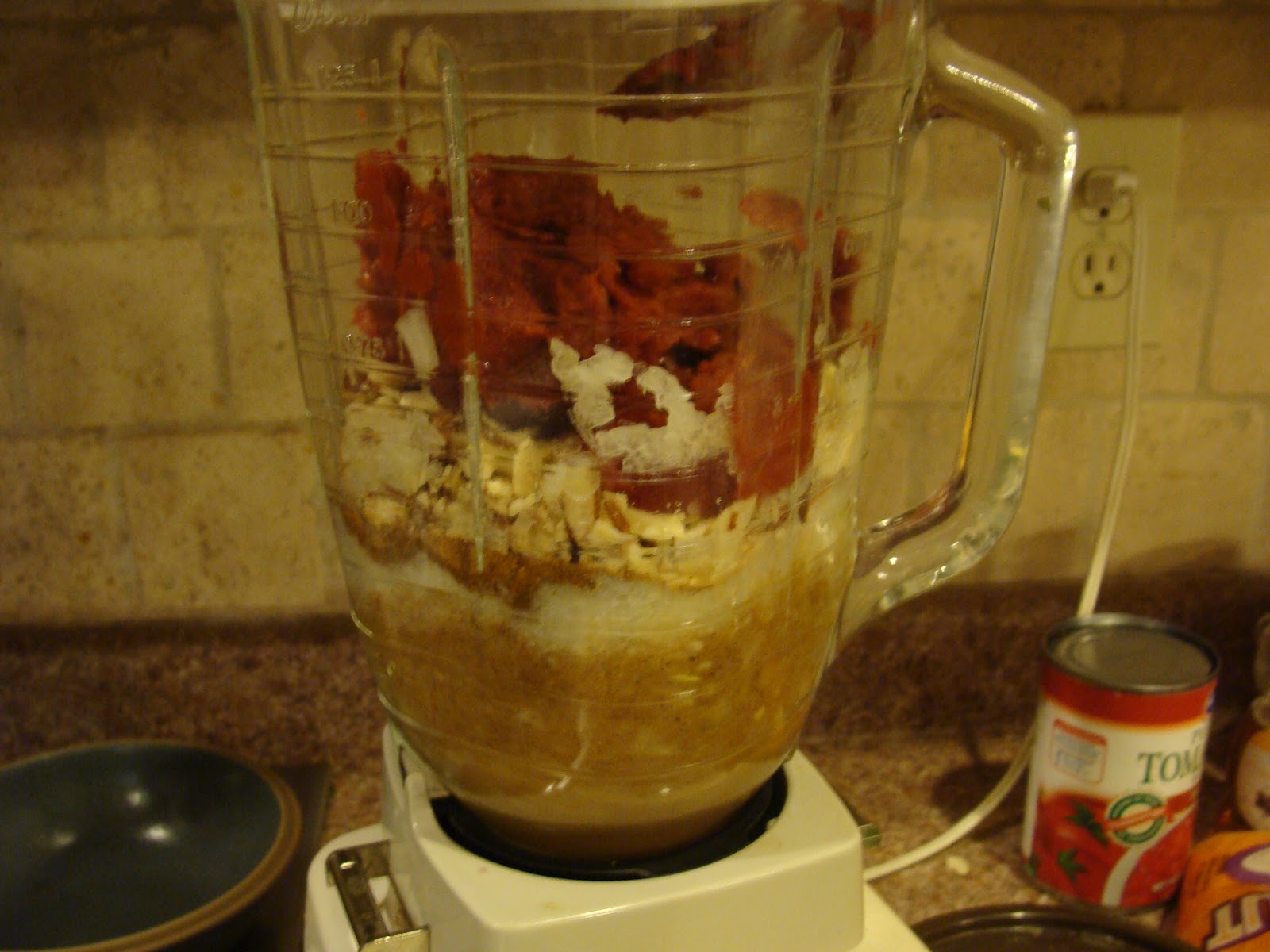
Okay, so that was a whole lot of prep work.  Cover your blender and blend the onions until they are very small and there's a lot of juice. You don't want to liquify them, but you want them fairly mushy. Turn off the blender once your onions are done. Add your spice mix, 3/4 cup slivered almonds, 2 tsp minced garlic, 1 Tbsp lemon juice, 2 Tbsp fat-free yogurt, and 6 oz tomato paste to the blender.  Blend well until you have a very thick liquid/paste with few discernible parts.  Make especially sure that all the almonds are well blended; you don't want any chunks (nothing says tasty quite like chunks. Say it with me... chunks).

Mmmm... you saucy thing, you
Pour your spicy sauce into your large pan.  Saute over medium heat (just above your stove's middle setting) for about 2 minutes.  By cooking the spices before you add anything else, you better release their flavors.  You don't need to stir it constantly, but make sure to do so regularly or the sauce will scorch (and burnt is not a flavor we're going for).

After two minutes, add the chicken and cilantro and saute along with the spices until the chicken has cooked on the outside.  You'll know it's time to move on when all the chicken has turned white and no pink is showing on the outsides.  Now open the cans of tomato sauce and diced tomatoes.  Drain the diced tomatoes over the sink (don't drain the tomato sauce, as that is self-defeating).  Add both cans to the curry and mix everything together well. Saute for a little longer at medium heat until the chicken is cooked through.

Measure out 1 heaping cup of golden raisins, packing them into the measuring cup by squishing them into the cup before adding more. The original recipe only called for 1 Tbsp of raisins, but they really make the dish (and, I clearly like raisins). Make sure to use golden raisins or sultanas, because regular raisins just aren't the same. (Please note that raisins cause kidney failure in pets!) Mix the raisins in well.  Cover the curry and reduce heat to low.
How does one say Voila! in Hindi?

Allow the curry to simmer while you finish the rest of the meal. Serve with fresh made naan, rice, and your choice of sides. Pictured here, you see mint chutney, aloo with cauliflower and mushrooms, ad brown rice. Now, try not to stuff yourself to bursting (it's only a thin mint).


    Pin It

Thursday, February 2, 2012

A Thorny Situtation

I picked up Mark Lawrence's Prince of Thorns on a whim.  It looked and sounded interesting (I mean, look at that cape),  but I was also a little afraid it could turn out to be really, really bad.  With a character as young as Jorg who is hell-bent on violent revenge, the plot could have come off as hackneyed and ridiculous (the lead character's snort-worthy name didn't help, either).  Fortunately, Lawrence is an exceptionally good writer, and he achieves an interesting combination of action and intellect that will keep readers turning pages.

The Basics
Lawrence, Mark. Prince of Thorns. New York: Ace Books, 2011. Print.

Mark Lawrence makes his authorial debut with the novel Prince of Thorns, and it's quite a hardcore start, I must say.  According to my in-depth research (also known as reading the back jacket), Lawrence is a research scientist in the field of artificial intelligence, is married, has four children, and resides in Bristol. Somewhere in amongst all that he found time to write the story of Prince Honorous Jorg Ancrath, and let's be glad he did.

The first novel in a planned trilogy, Prince of Thorns features a spiffy jacket and an even spiffier plot line. Having watched his mother and brother be brutally murdered, young Jorg wants revenge and sets out to get it. He joins and eventually leads a band of bloodthirsty "brothers."  As the story opens he returns to his homeland and his father's court, where he finds more violence and treachery (cause there's no place like home).

The Book
I was initially put off by the first chapter or so of the book.  Lawrence goes for the gut (literally) with his opening, and I was worried that I'd find the book unreadable.  It opens with the razing of an entire village in a scene filled with violence and gore led by Jorg and his fellow thugs.  Jorg is not just an anti-hero, he's downright evil, and at first I found him completely unlikable.  But as you read, you soon realize that Jorg is a product of his world.  Violence is the norm in this war-torn world, as the nobles of each country and province wage war on each other for the right to rule as emperor.  Jorg is ultimately no worse than any of the other leaders in the world.  In fact, he's better because he's something of a military genius and he refuses to tolerate others leading him along for their purposes.  That's a whole lot more than can be said for any other leaders in the book.  It helps, also, that Lawrence is not overly graphic with the violence.  It's there, but he nicely balances what reader's witness with what they're simply informed of.

I also liked Lawrence's use of flashback throughout the novel.  Some might find it jarring, since the story frequently and quickly switches between the Jorg of the present and the 10 year old Jorg of 4 years earlier.  However, I like that it provides the present story line at almost the same time as is provides relevant back story.  The shift is always connected to the current development, and any remaining lack of flow in the narrative suits the jarring nature of the violence and depravity ongoing in the novel.

Another potential complaint might be the lack of character development.  Jorg is really the only character with any visible depth to him.  All the others are either shrouded in mystery for plot purposes, like the villainous sorcerers, or simply one-note characters, like Jorg's "Brothers."  This bugged me at first, but then I realized that it made sense. The story is told through Jorg's point of view, and he's practically a sociopath.  He cares very little for the inner workings of his cohorts, so it makes sense that we see them only through their actions and the parts they play in Jorg's battles.  We see the beginnings of development and deeper character in those people that Jorg takes further interest in (that he cares about, even as he tries to stamp it out), like the Nuban or Makin, in whom we find some actual personality traits and quirks.

I especially enjoyed the conclusion of this novel, since the last quarter started off with a twist that I didn't see coming.  I love it when books surprise me.  We also start to get a glimpse at some of the more subtle plot threads that work in the background and the manipulation of those eligible to hold the throne of the empire.  These promise a more complicated plot in the novels to come. Also, Jorg's discovery of these inner workings allows him to focus his violence and anger with greater purpose than he began the novel with.  I liked seeing Jorg's growth over the course of the novel and the promise of further growth to come. I'm sure he'll continue to be violent and kill without conscience, but I also think he'll have better developed reasons for his actions.

Lastly, I got a little thrill as I began to recognize the setting of the novel, which I won't ruin for you by being overly descriptive.  I started the novel with a sense of misgiving and a strong suspicion that I'd find it pointlessly violent and unenjoyable.  Instead, I got an unexpectedly excellent read in the form of dark coming of age story that left me eagerly anticipating the sequels.

Extras

   Pin It